Your vehicle
No vehicle selected
Identify yours to refine your search results
No vehicle selected
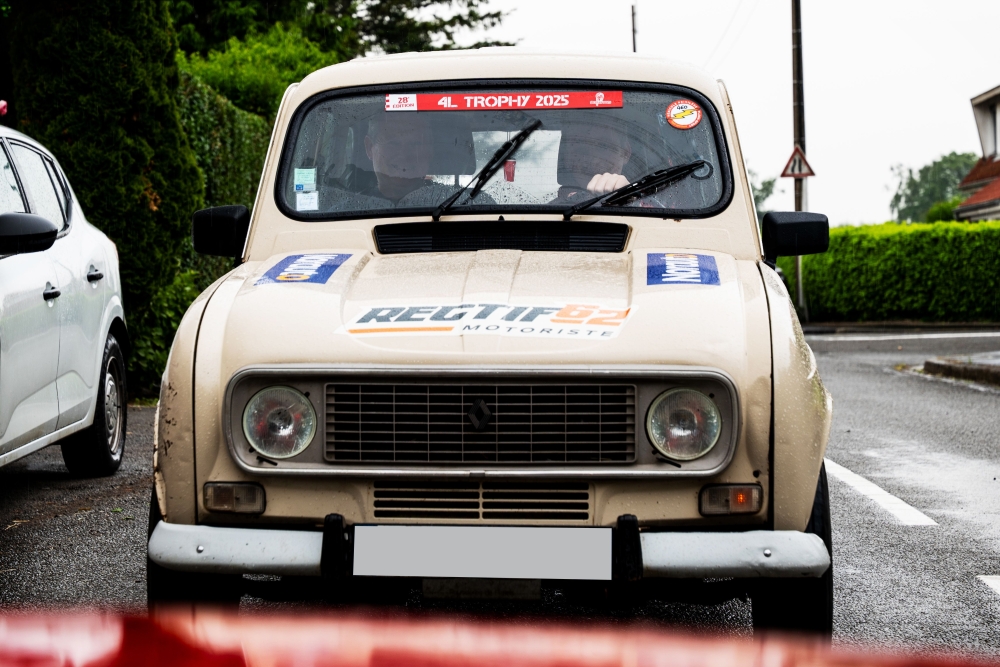
Solid, simple, lovable and built for every road, the Renault 4, a.k.a. the 4L, has spanned decades, continents and generations. Van, family car or off-road adventurer, it remains a legend of French motoring.
27/01/2026
Harald
6 minutes read
Renault
Renault 4L
It is easy to find people who knew the 2CV or the 4L because someone in their family had one. That is how you recognise a true people's car: its ability to permeate the motoring landscape and to circulate in it like a possession handed down through the generations. Let's take a closer look at this icon, born in the Billancourt factories.
Renault shook up the rules by presenting its new people's car at the 1961 Paris Motor Show: the Renault 4. Alongside it was the Renault 3 or R3, a sort of budget R4, more stripped-down, aimed at the 3 CV tax bracket.
With the 2CV, Citroën had had a front-wheel-drive people's car in its range since 1949. The Renault 4CV was ageing and it was crucial for the diamond brand to reply to the chevrons by offering a truly versatile vehicle that would appeal to men and women alike.
A masterly publicity stunt at the 1961 show: the "take the wheel!" operation: 200 Renault 4s were parked in the streets of Paris and made available for the public to try. Some 60,000 test drives were carried out during this event. The car was a big hit, especially with women.
From its launch, the van version delighted craftsmen, farmers and shopkeepers, who proudly displayed their names and advertisements on its sides. It could carry 300kg with a load volume of 2m3; practical, it proved as reliable as it was sturdy.
The name 4L, or Quatrelle , has its origin in the Renault 4's commercial range. At its launch, it was offered in 3 versions: the R3, the standard R4 and a more luxurious version, the R4 L, L for limousine and/or luxury. Just like the 2CV, the 4L is a Limousine (6 side windows) in the coachbuilder's sense of the term.
It is a 4 CV tax rating car, just like the Renault 4 CV, already well known under that name, used for the grandmother that came out in 1947. The Régie and its customers preferred to use the shortened names R4 and then 4L, more modern, to refer to this new people's car.
The 4Ls of La Poste, EDF-GDF, the Police, the Gendarmerie and the fire brigade (including the 4x4 version with Sinpar) criss-crossed every road in France, helping to establish this people's car as a benchmark in motoring.

With its blue and yellow livery.
The Marreau brothers' 4L; a 4L Sinpar 4x4 powered by an R5 Alpine Gr2 engine. It finished 3rd in 1980.
First orange with a white roof and a big black diamond, the livery of the assistance vans changed to black, white and yellow; it rescued road users for a long time all over France.
Souped-up as a customs 4L in "Nothing to Declare", as a yellow van decked out with the coat of arms of the lords of the Post Office in "The Visitors", as a rugged 4L across the desert with Jean Reno (not Renaud, nor Renault) at the wheel in "4L", as an off-road 4L in "Romancing the Stone", etc.
It is a humanitarian raid rally run by students, setting off from Paris and heading for Morocco … in a 4L, of course. It is adventure in a 4L, in complete safety, on a small budget and in a spirit of solidarity, especially in the sand dunes when it comes to pushing! Created in 1998, this event brings together more than 1,000 crews every year. That is 2 students and one car; the car is prepared and made reliable to last the 6,000 km of the route and carry 50 kg of school supplies to hand out to children. The 4L Trophy is one of the unmissable events on the student scene.
All of these iconic models could almost be considered special editions of the 4L.
After the success of rolling out its Dauphine internationally, the Régie Renault set off to conquer the 5 continents with its R4. The idea adopted was that it is better to set up and build on the spot than to export.
With its R4, Renault went on to conquer the world and the 4L was built:
The adventure's definitive end came in 1994, after the last 156 4Ls were assembled in Spain's plant.
More than 8 million 4Ls were thus born: 8,135,424, officially.
This people's car, born at the right time and actively rolled out around the world by Renault, won over the parents of the 60s and 70s and the young people of later generations.
This good old 4L is a Swiss Army knife of a car, solid, reliable and easy to maintain; having become legendary, it did not survive manufacturers being required to move to the catalytic converter and therefore to fuel injection. "The 4L-ytic converter killed it" …
The 2025 Renault 4 E-Tech electric will no doubt not have the same aura; just a namesake, at best.

Harald
Le partage de la Passion, simplement.
Subscribe to our MECATECHNIC newsletter