Your vehicle
No vehicle selected
Identify yours to refine your search results
No vehicle selected
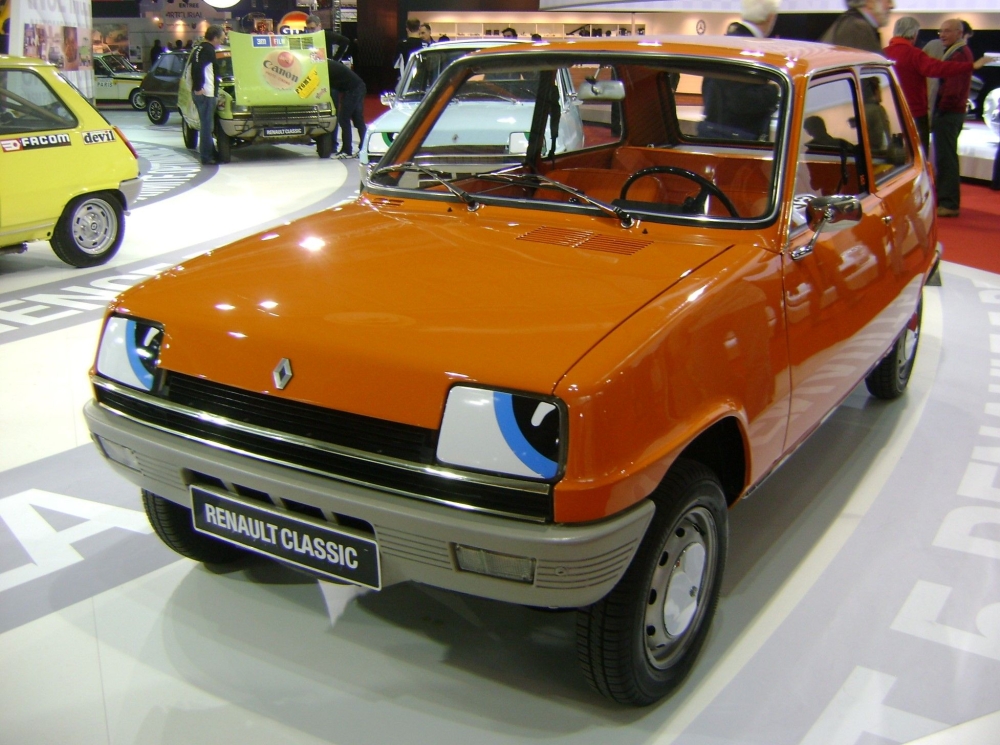
Launched in 1972, the Renault 5 revolutionised the modern city car. From the 782 cm³ version to the legendary Alpine and Turbo, a look back at a people's icon turned collectable.
13/04/2026
Harald
8 minutes read
Renault
Unveiled on 28 January 1972, the Renault 5 shook up the rules of the small car market.
The magic worked in ways Renault had not really expected. Its "little car" is versatile and functional; thoroughly urban, it brings what its predecessors had lacked until then: charm.
This charm would win over 5,700,000 customers in 14 years; quite a career!
In the "5 fiscal hp" segment, the scrap between small front-wheel-drive cars looked set to be fierce, with the Fiat 127, the Peugeot 104 and another modern city car that poked its nose out in 1974: the VW Golf 1.
It is a small, elegant and modern car, 3.50 m long. It rediscovers the sense of style somewhat lost by the Renault 4 and 6, originally created to be "useful", that is, more functional than desirable; the R5, for its part, combines the two and lets Renault offer a versatile car, both a road car and a town car.
The R5 appears as a new type of vehicle, suited to modern city life, supermarket runs, and weekend escapes to the countryside or the coast. Its tailgate (the third door) and folding rear seat suit this wonderfully.
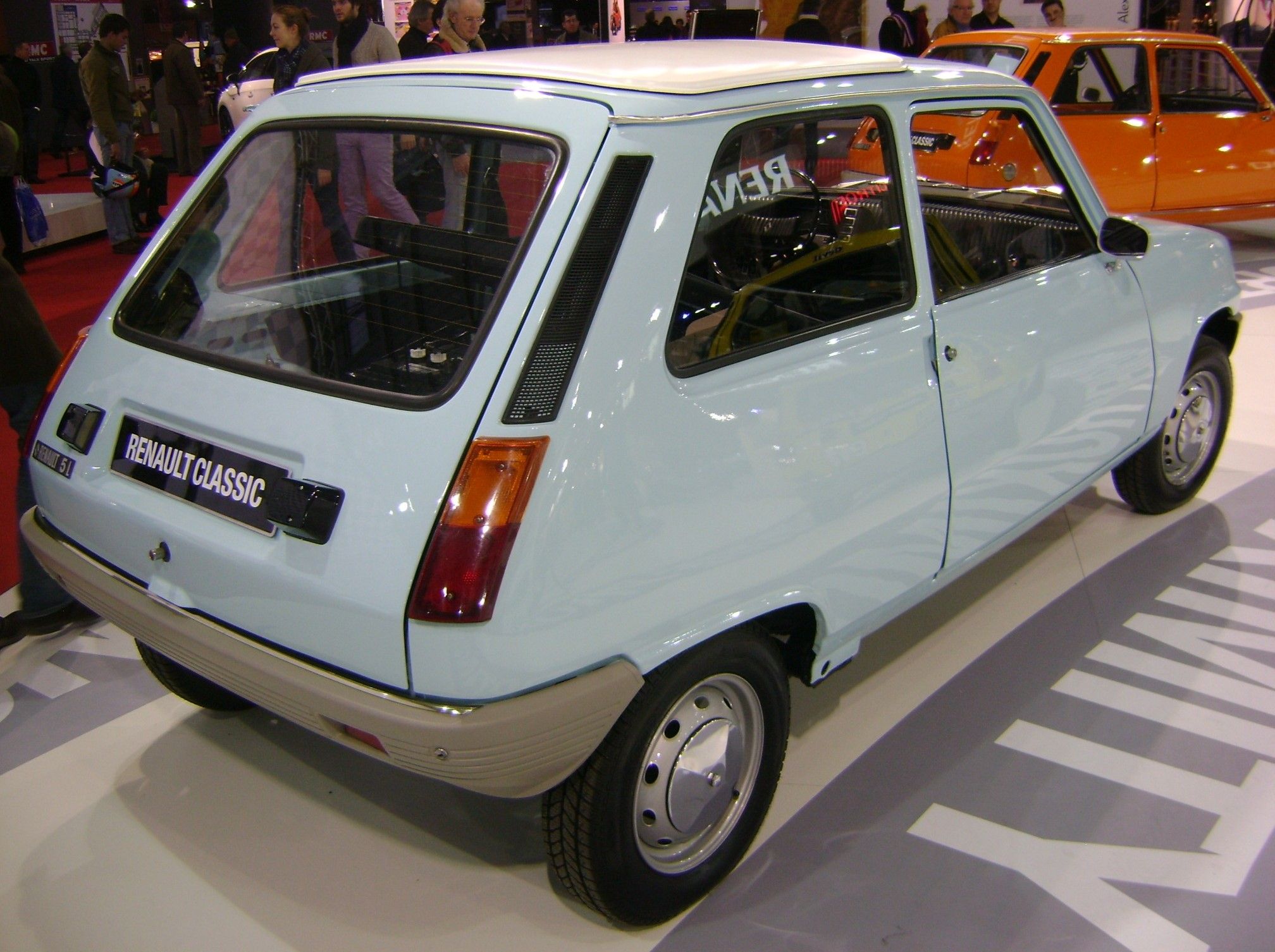
Unlike its big sister, the 4L, it is not assembled on a separate platform but benefits from a more modern and more rigid monocoque body.
It uses many components proven on the 4L, R6 and even R12, which keeps its development and production costs down.
At launch, its engines derive from those of the 4L and Renault 6; they are installed in the same way on the R5, set well back towards the cabin, with the gearbox in front.
The basic R5 has a 782 cm3 three-bearing engine: the "Billancourt engine" of 4 fiscal hp for 33 hp developed.
The R5 TL moves up to 956 cm3 (5 fiscal hp / 44 hp), fitted with the famous "Cléon engine", derived from the 5-bearing engine of the R8.
The R5 uses torsion bar suspension that gives it remarkable road holding despite a tendency to roll in corners and at roundabouts. This body roll is a well-known "standard option" to owners of the 4L and especially of the 2CV, which have long-travel suspension!
The Renault 5 has a vertical, ribbed vinyl dashboard (until 1979), with simple instrumentation and switches, as on the 4L. Until 1977, the gear lever is on the dashboard (like the R4 and R6) and a floor-mounted lever became an option from 1973.
On the outside the Renault 5 innovates with its 2 wraparound bumpers made of glass-reinforced polyester; they accept light contact without deforming; perfect for getting around the (new) urban jungle.
In summary, the R5 proves modern in appearance but had to give up really being so technically, using many parts from its sisters the Renault 4 and Renault 6.
The Régie fitted its little R5 perfectly into the modern context of the new society breaking with the past that emerged after May 1968.
The 5 is an easy, safe, comfortable car, built to appeal to an urban female clientele who work and are on the move.
In the 70s, among rather well-off families, the need for a second car was felt.
The R5 is a 2-door, which seemed out of step with the standards of the time: "a car must have 4 doors to be versatile". Access to the rear seats is made easier by front seats that tilt fully forward and allow 4 adults to sit comfortably. The R5 is thus ideal for a small family, up to 3 children.
Its soft folding sunroof (optional), in the style of the Fiat 500's, even lets you taste the (almost) joys of the convertible; with the R5 you experience the road in freedom.
Alongside the classic colours needed to sell a car, Renault went flashy: bright orange, acid green, the reddest of reds … it's pure Seventies! The Twingo would repeat the boldness of its grandmother and enjoy the same success.
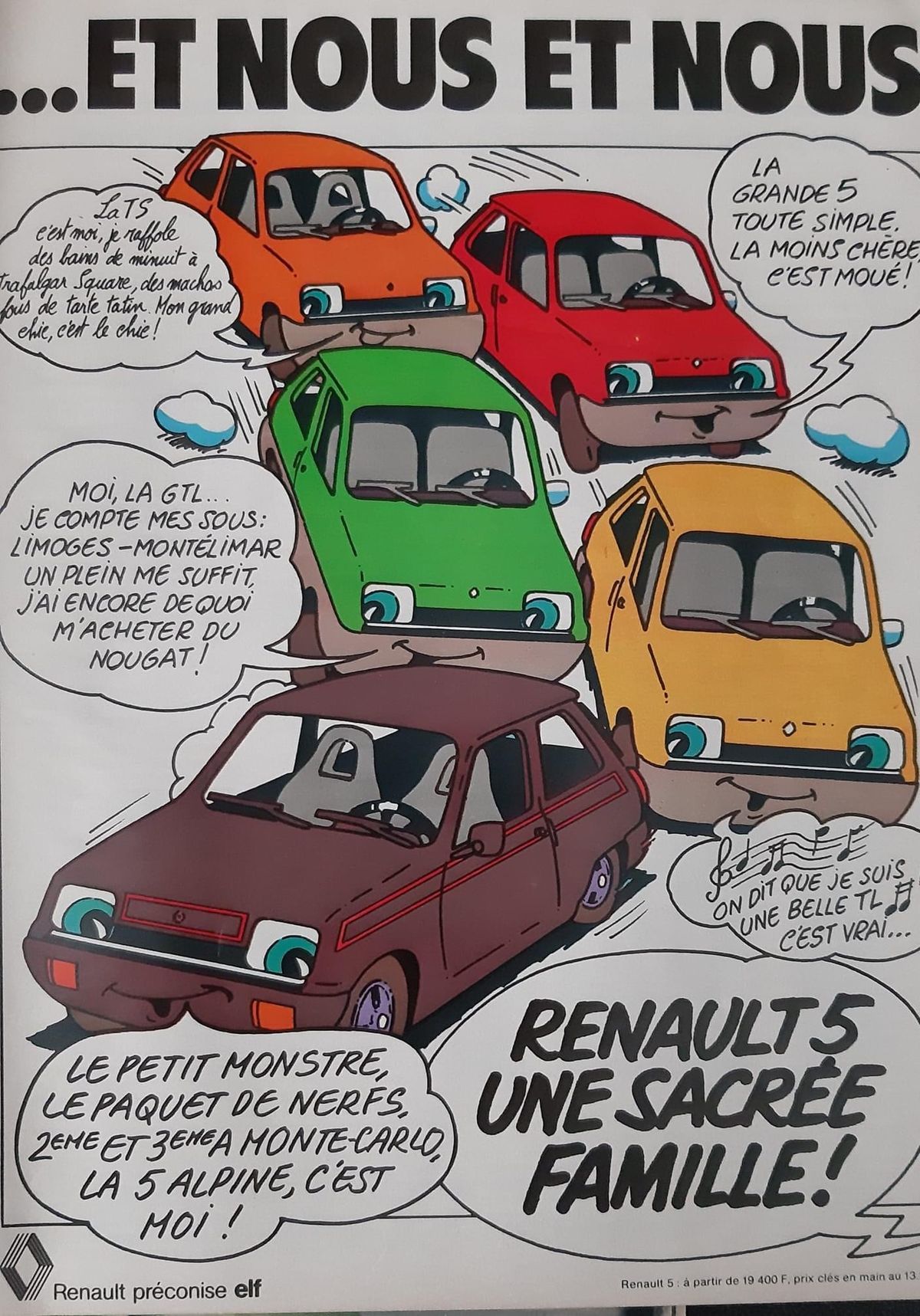
The R5 is an innovative and desirable car; it arrives at the right time with the right selling points; it is going to be a smash! You could even say it will be a "cartoon" smash.
Publicis was at the controls of the Renault 5's advertising launch. The agency made the R5 talk by launching it in both comic strips and cartoons. Its nickname is "Supercar"; "it's ready for any adventure, in town and on the road" says the slogan. Its headlights are blue eyes and its mouth moves through its front bumper. This car talks to you, tells you its life story, it has a soul.
Did Renault (Publicis) thus invent "Cars" long before Pixar?! This offbeat communication appealed to the target audience and above all to children, who championed it within the family. Does it really need advertising? The Flins factory couldn't keep up, so many orders were pouring in from France and Europe!
In late April 1974, the R5 LS and its 64 hp 1,300 cc engine brought a little "dash" to the R5 range; yet we were in the middle of the oil crisis.
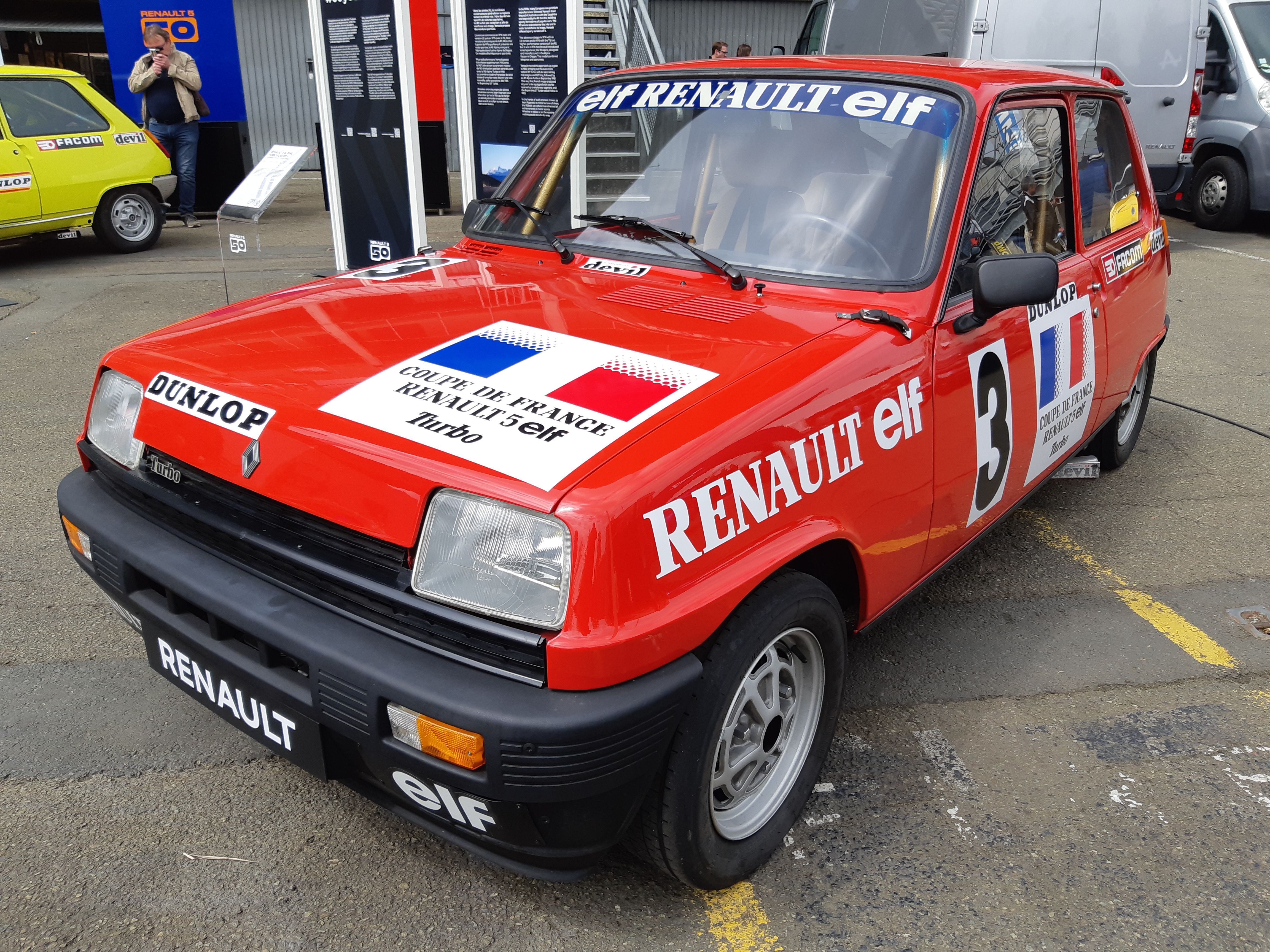
The Renault 5 Alpine (93 hp) followed in 1976 to try to respond to the arrival of the more powerful Golf 1 GTI. The Renault 5 Alpine Turbo pushed the envelope a little further by replacing it for the 1982 model year, with its 110 turbocharged hp.
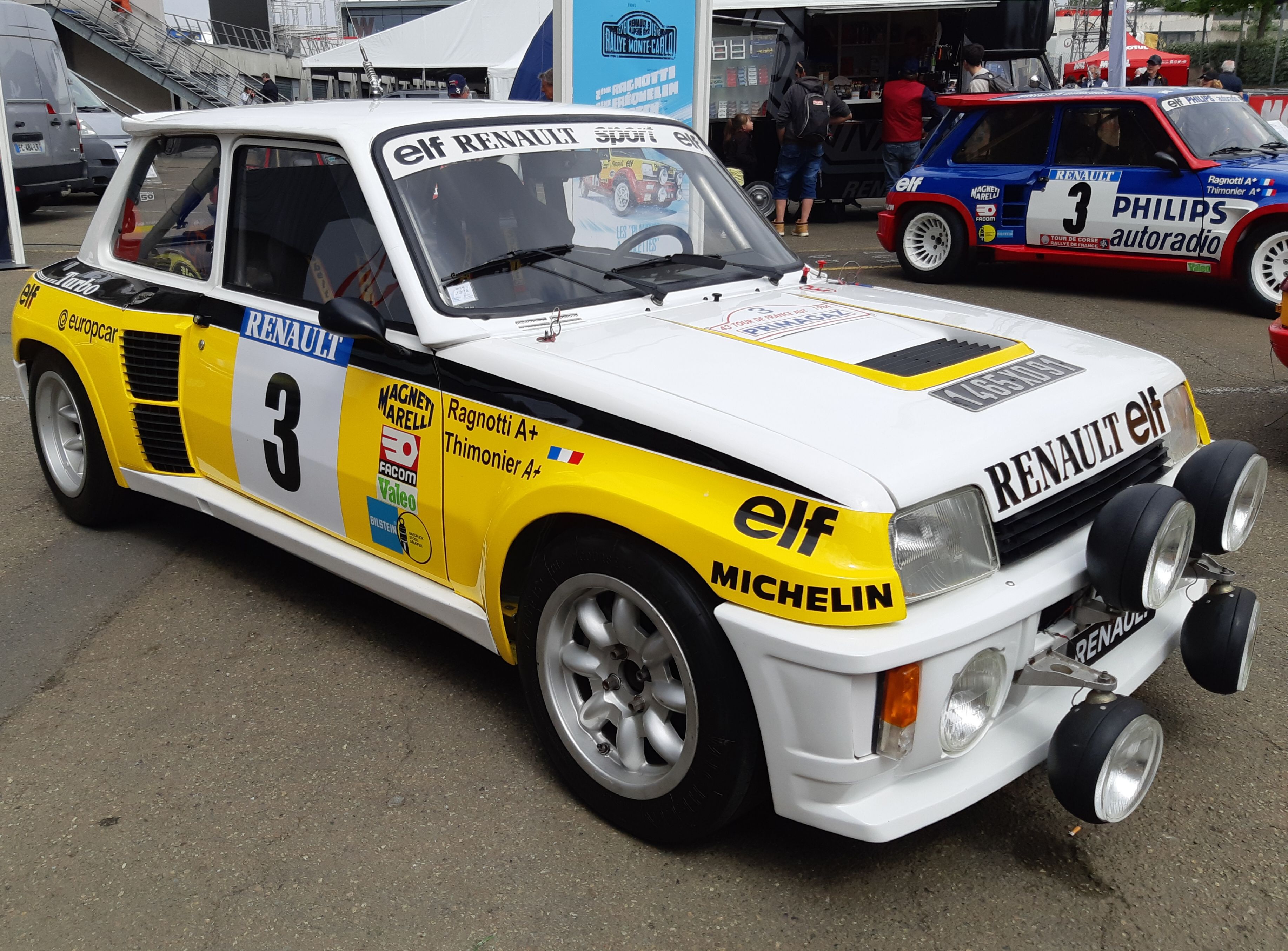
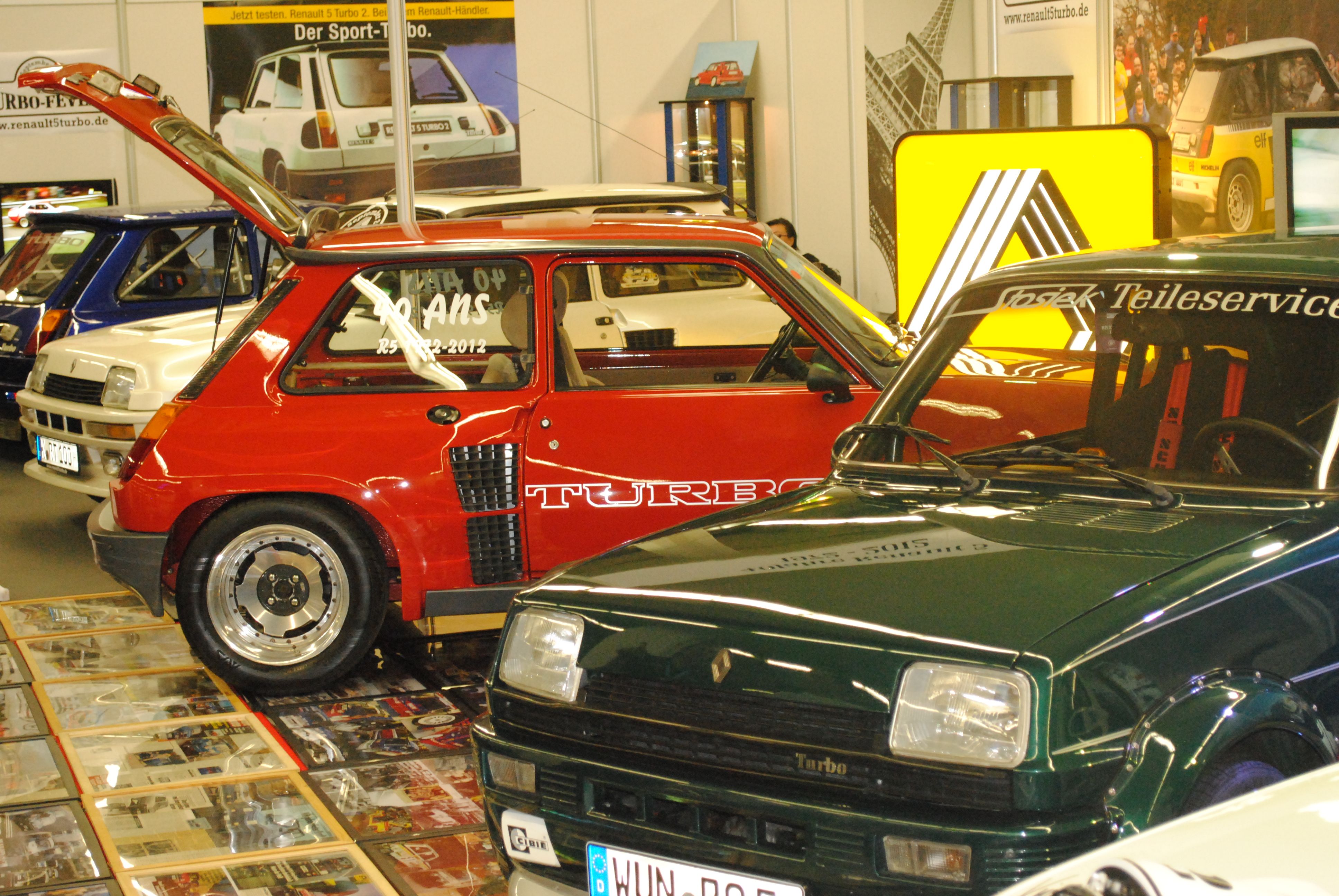
The legendary R5 Turbo would crown the range with its 160 hp in 1980 and its many victories in competition.
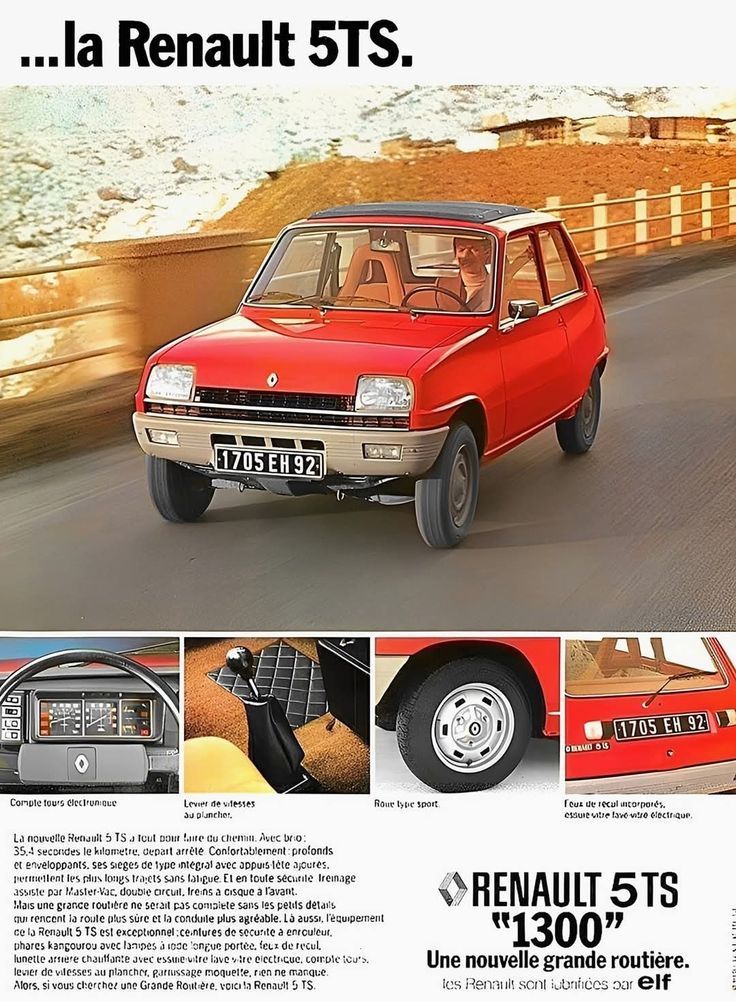
The Renault 5 got 4 doors from 1980, at the time of its small interior restyle. When you are born good-looking, you can do without touch-ups.
So it was inside that the big update took place: a new foam dashboard in a light colour, matching the seats and panels, new controls, a new steering wheel and the fitting of handsome so-called "petal" seats. Sound insulation improved (engine bonnet), the centre console was better equipped; in short, the 5 modernised.
In 1982, the R5 gained a more luxurious trim with the R5 TX, which appeared. Its 63 hp 1,400 cc engine is that of the TS, on which it is based. It is fitted with AMIL alloy wheels, takes the Turbo's sand-coloured interior with electric windows, 4-speaker radio pre-wiring, a leather-wrapped sports steering wheel, etc.
With the end of its reign approaching and sales declining, the Régie brought out several special and limited editions which, as well as revitalising the Renault 5's image, would let it clear stocks of parts (unsold options, wheels, glass sunroofs…) and engines, before the arrival of the Supercinq.
It is mainly outside France that these limited editions were offered: R5 Coach, R5 Campus, R5 Super Campus blossomed in France, R5 Saint Moritz, R5 Saint Tropez, and the R5 Le Car in Switzerland, R5 Super Car, R5 Avenue, R5 Collège in Belgium, an R5 Parisienne in Holland, an R5 Exclusive in Sweden, etc.
The R5 became the R5 Lauréate, four months before the arrival of its replacement, the Supercinq. This let Renault rationalise its production and range for its final curtain. The R5 L, TL, GTL and Turbo became Lauréate; their bumpers were body-coloured and they all wore FERGAT steel wheels in the style of the Renault 12 Gordini.
The R5 was for Renault what the 205 was for Peugeot: a locomotive that appeared at the right time to pull the other carriages of the range.
It is a pity that R5s suffered from rust problems and that many of the survivors were decimated by the scrappage schemes meant to rejuvenate the French car fleet.
In its classic versions, it took a while to attract the interest of collectors, who dwelt more on the R5 Alpine and Alpine Turbo. But it would get its revenge in the end, as with Alpines getting scarce, beggars can't be choosers …
Supercar thus gave way to Super 5, after 14 years of success; the latter would have its work cut out to counter another future Youngtimer of note: the 205.

Harald
Le partage de la Passion, simplement.
Subscribe to our MECATECHNIC newsletter