Your vehicle
No vehicle selected
Identify yours to refine your search results
No vehicle selected
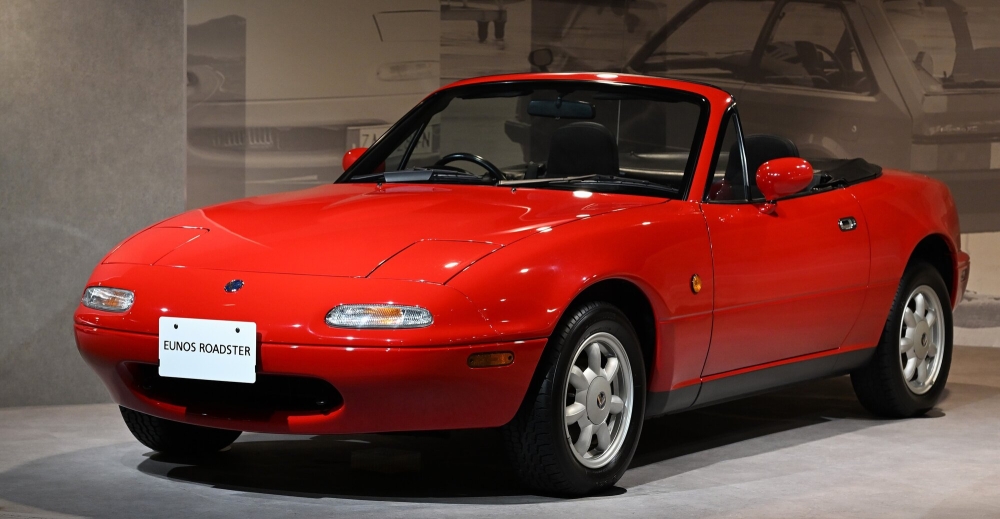
In the late 1980s, the small affordable roadster had almost disappeared. Mazda brought it back to life with the MX-5 NA: its history, its engines and what to check before buying one.
22/10/2026
Harald
7 minutes read
At the end of the 1980s, the small affordable British-style roadster had almost vanished from the catalogues. Safety and emissions rules had done for its representatives, and manufacturers no longer believed in it. Mazda made the opposite bet: a light, front-engined, rear-wheel-drive two-seater, reliable and affordable. The first-generation MX-5, known as the NA, would prove it right well beyond its hopes. A look back at a car that has become a sought-after youngtimer, and at what you need to know before buying one.
The story begins in the United States. A journalist at Motor Trend magazine, Bob Hall argued as early as the mid-1970s to Mazda's executives for a small roadster in the spirit of British sports cars. He then joined Mazda USA in product planning, and in the early 1980s he got the studies launched.
The inspirations are clear: the small English roadsters of the 1960s, and in particular the Lotus Elan, whose spirit can be seen in the pop-up headlights and the simple lines. Bob Hall himself pointed out that the Elan was only one reference among others. The philosophy Mazda adopted comes down to two words, Jinba Ittai: horse and rider as one. Everything is designed for lightness and driving pleasure, more than for raw power.
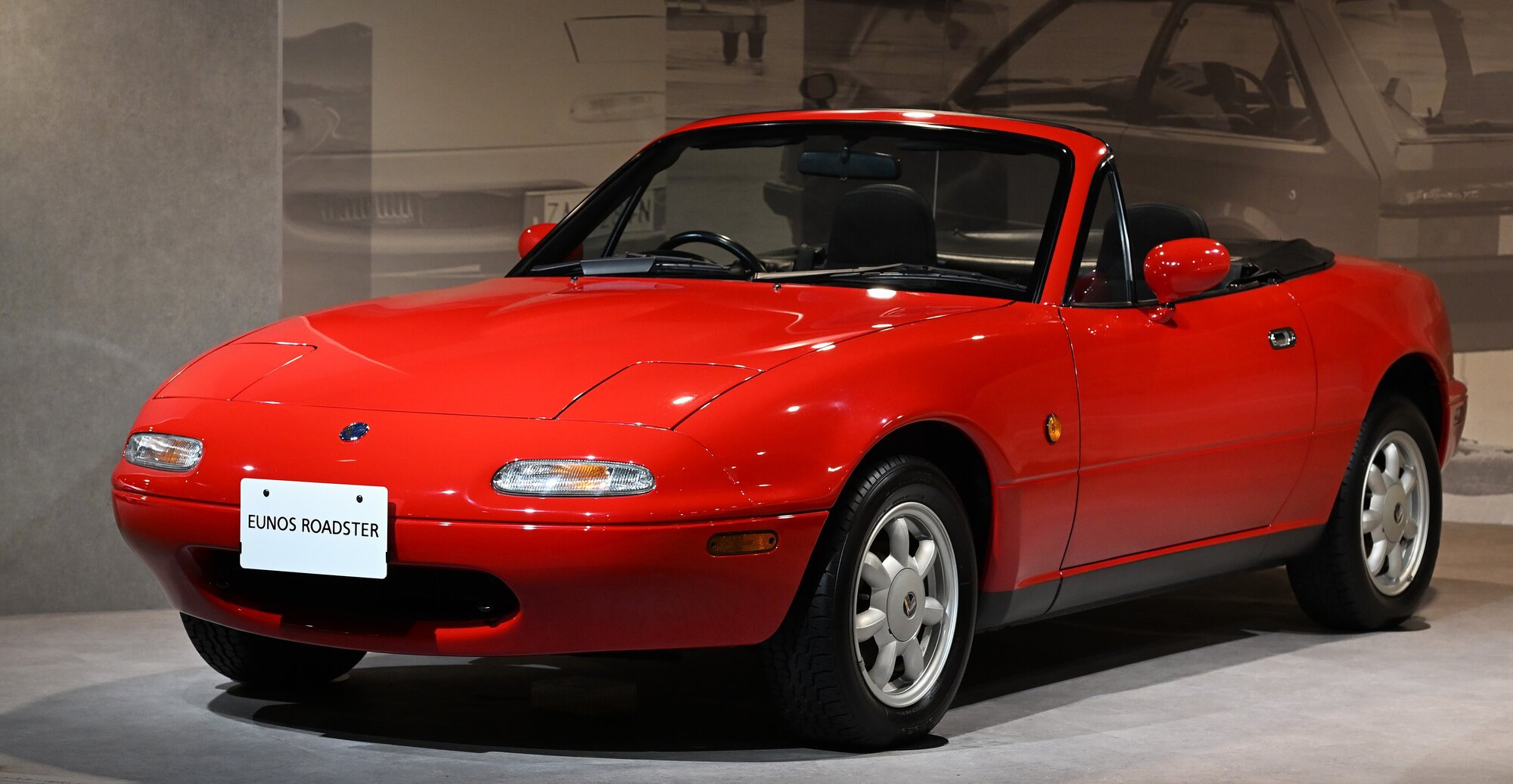
The MX-5 was unveiled at the Chicago Auto Show on 10 February 1989. It took the name Miata in North America and Eunos Roadster in Japan, where it was sold under the Eunos brand, and arrived in Europe soon after as the MX-5. The recipe fits in a few lines: longitudinal front engine, rear-wheel drive, five-speed manual gearbox (an automatic also existed), under a tonne unladen, fabric soft top and pop-up headlights. Success was immediate, and the NA would be built in 431,506 examples until 1997.
At launch, the MX-5 received a 1.6 l twin-cam 16-valve of 115 hp, engine code B6. With the Series 2 of 1994, a 1.8 l of 130 hp (code BP) appeared. It didn't replace everything: in Europe, a 1.6 l detuned to 90 hp sat alongside it at the bottom of the range. To identify yours, the engine code letter appears in the serial number; our page on Mazda MX-5 NA engines explains how to read it and gives the matches by period.
These engines have a reputation for being solid, provided they have been maintained. On the early 1.6 l engines, one fault is well known: the short-nose crankshaft, whose pulley key can wear. With the engine idling, the crankshaft pulley must not wobble; at the slightest doubt, have the car checked by a specialist.
The Series 2 isn't just the 1.8 l. To meet new side-impact standards, the body was clearly strengthened, with a clearly visible bar between the belt towers, behind the seats, and reinforcements on the front and rear subframes. Depending on the market, a Torsen limited-slip differential appeared. The car gained in rigidity what it lost a little in lightness: around 990 kg unladen, against about 980 kg for the early ones.
Which to choose? The Series 1 with the 115 hp 1.6 l engine is the truest to the original idea: light and lively in the revs. The Series 2 with the 1.8 l engine offers more torque and a stiffer body, welcome on poor roads. The rarer 90 hp 1.6 l suits relaxed driving. In every case, the condition of the body must come before the version: a rusty Series 1 will always cost more than a sound Series 2.
The pop-up headlights are the signature of the NA: the next generation, the 1998 NB, switched to fixed headlights. They are part of the charm, but their motors and mechanisms need a little attention with age.
The NA also saw many special editions, especially in the United States. The first, the 1991 Special Edition, paired British Racing Green paint with beige leather upholstery, in about 4,000 examples. In 1995, the M Edition in burgundy red (Merlot) was built in 3,500 examples. If you are shown a limited edition, ask for the documents that prove it: colour, equipment and serial number must match.
The mechanics are rarely an NA's problem. Its enemy is rust, and it often comes from the soft top's water.
A hard top was offered as an option from launch. If the car has one, it's a real plus for winter driving; stored separately, it keeps better on a trolley or a wall mount than directly on the floor, where it gets scratched and deformed.
For the inspection, put the car on a lift if possible. Look at the sills from outside and inside, lift the carpet on the passenger side and in the boot, open and close the soft top to judge its condition and its watertightness, and operate the pop-up headlights several times: both must rise and fall together, without hesitation. A test drive should finally confirm a precise gearbox and an engine that revs freely.
Beyond its figures, the NA above all proved that there was still a clientele for a small, simple, light, rear-wheel-drive convertible, years after the disappearance of models like the MG B, the Triumph Spitfire or the Fiat 124 Spider. In its wake, several European manufacturers returned to the roadster in the 1990s. Mazda, for its part, never abandoned the recipe: every generation of MX-5 has stayed true to the lightness and rear-wheel drive of the first.
A sound, maintained, garaged MX-5 NA remains one of the simplest and most affordable ways to taste the classic roadster, with a reliability its English ancestors never knew. Find all our parts for the Mazda MX-5 NA, and our article on how to winterise your classic car properly to keep it dry through the bad season.


Harald
Le partage de la Passion, simplement.
Subscribe to our MECATECHNIC newsletter