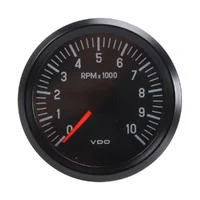
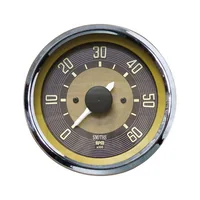
Replacement or additional instrument
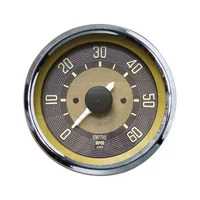
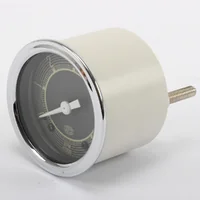
- The replacement rev counter replicates the layout, scale and style of the original dashboard. This is the ideal choice when the original instrument has failed and the car must remain compliant.
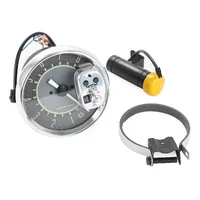
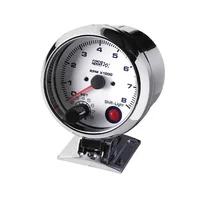
- The additional rev counter is fitted as an extra, either on a stand, in a bracket or recessed into the dashboard. This is the solution for a vehicle supplied without a rev counter, which was common on basic trim levels.
In both cases, check the dial diameter: car instruments follow standardised diameters, and it is this measurement that determines whether the instrument will fit into the existing housing or into a standard bracket.
Where does the signal come from?
A rev counter counts pulses and converts them into revolutions per minute. However, it must first receive the correct pulses.
- Conventional contact-break ignition: the signal is taken from the negative terminal of the ignition coil. This is the most common connection on older vehicles.
- Electronic or transistorised ignition: the coil does not always provide a usable signal, and some modules have a dedicated output for the rev counter. Fitting a gauge designed for a contact breaker to this type of ignition system will result in erratic readings.
- Number of cylinders: the number of pulses per revolution depends on this. A universal gauge can be adjusted accordingly, either via a switch or by setting parameters, whilst a dedicated gauge is wired for a specific configuration.
- Older diesel engines without spark ignition: in this case the signal comes from the alternator or a sensor, and not all rev counters are compatible with this.
Check this point before considering the dial style: it determines how the instrument works.
Diameter, scale and style
- The diameter can be measured on the removed instrument or on the housing. Common sizes range from small recessed dials to large dashboard instruments, including a very common intermediate size.
- The maximum scale must match the engine. A dial with a very high scale on an engine that does not rev highly makes the needle illegible within the useful range, as all the action takes place in the first third of the dial.
- The style must complement the other instruments: black or light-coloured background, chrome or painted bezel, and the shape of the numerals and the needle. A modern rev counter next to a vintage speedometer stands out immediately.
- The shift light, which indicates when to change gear, is fitted to certain models. Useful on a tuned vehicle, but anachronistic on a faithful restoration.
Fit it properly
A measuring instrument cannot tolerate a haphazard power supply. Ensure a proper earth connection, taken from a stripped metal panel rather than a painted screw, and a positive supply from the ignition circuit protected by a fuse. A poor earth connection causes the needle to wobble and the reading to drift – a fault often mistakenly attributed to the instrument itself.
Remember to connectthe diallighting to the side-light circuit so that the instrument lights up along with the rest of the dashboard. And route the signal wire away from the spark plug cables: interference from a high-voltage ignition system is enough to cause the display to flicker without any actual fault.