Your vehicle
No vehicle selected
Identify yours to refine your search results
No vehicle selected
Left untouched for ten years at the back of a house, a 2CV6 is back on the road within weeks. Julien tells the story of getting it going, then restyling a Deuche that makes everyone smile.
22/10/2026
Harald
6 minutes read
Some cars you buy on impulse, and others come back looking for you. For Julien, the 2CV belongs to the second category. His very first car, when he passed his test, was a 1975 2CV4 paid for with a handful of francs. He rather hated it: his mates drove GTIs or GT Turbos, and he drove a Deuche. Its only advantage, and not a small one, was that it went anywhere, fields included.
Sold on for a Renault 4, then forgotten as later cars came and went, the 2CV never quite left his mind. A friendship struck up with a Deuche nut finally convinced him: one day, he would have one again. That day came in December 2018, during a visit to a private seller. As so often with classics, the car came to him rather than the other way round.
In a corner of the house slept a 2CV6, off the road for about ten years. Julien took down the owner's details, called him back and asked the only question that matters: is it for sale, and at what price? The deal was done at a three-figure price. With his father's help, he brought the car back on a trailer to his garage.
What followed was a pleasant surprise. A clean, the tyres pumped back up, and the flat-twin agreed to start. Then it took two to three weeks of adjustments for everything to work properly, after which the Deuche passed the roadworthiness test (contrôle technique) without difficulty. It is a step not to skip: a car coming out of long storage must be inspected before going back on the road, if only for the insurance.
Julien's experience recalls the basic checks before driving a car that has slept for a long time:
For storing a classic, our article How to winterise your classic car properly details the right habits, which avoid ending up with a full recommissioning.
Once the car was in order, the ideas came. Julien turned to a 2CV customisation specialist to imagine the modifications, and a friend found him a set of wide wheels and rear wings. The whitewalls came from Mecatechnic: the kit of four extra-wide whitewalls for 15-inch wheels dresses the original wheels without touching the tyres. The car was also lowered.
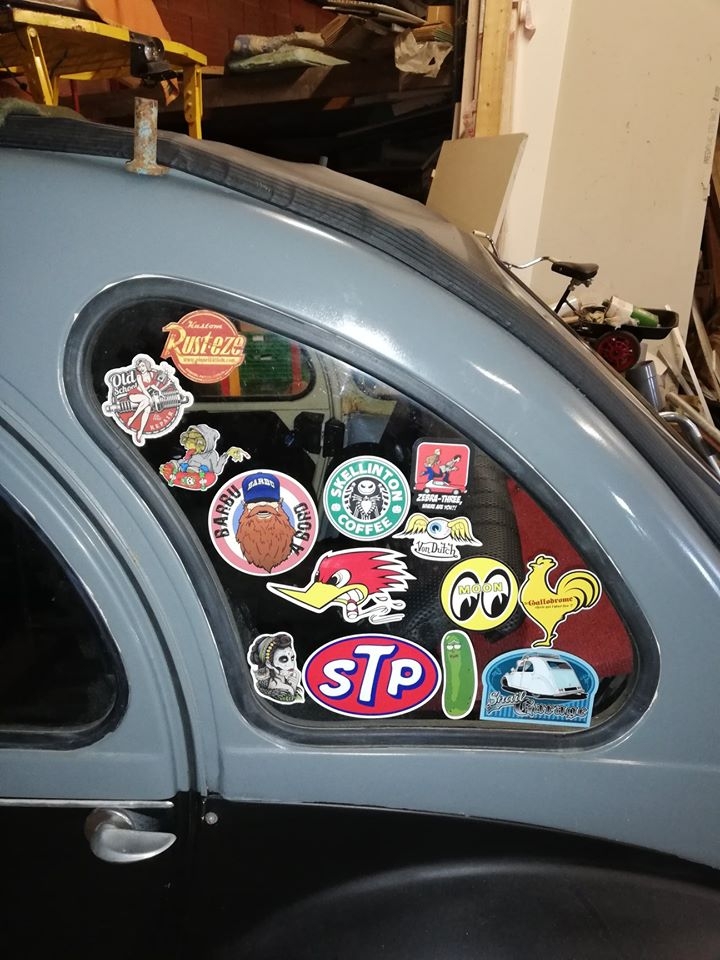
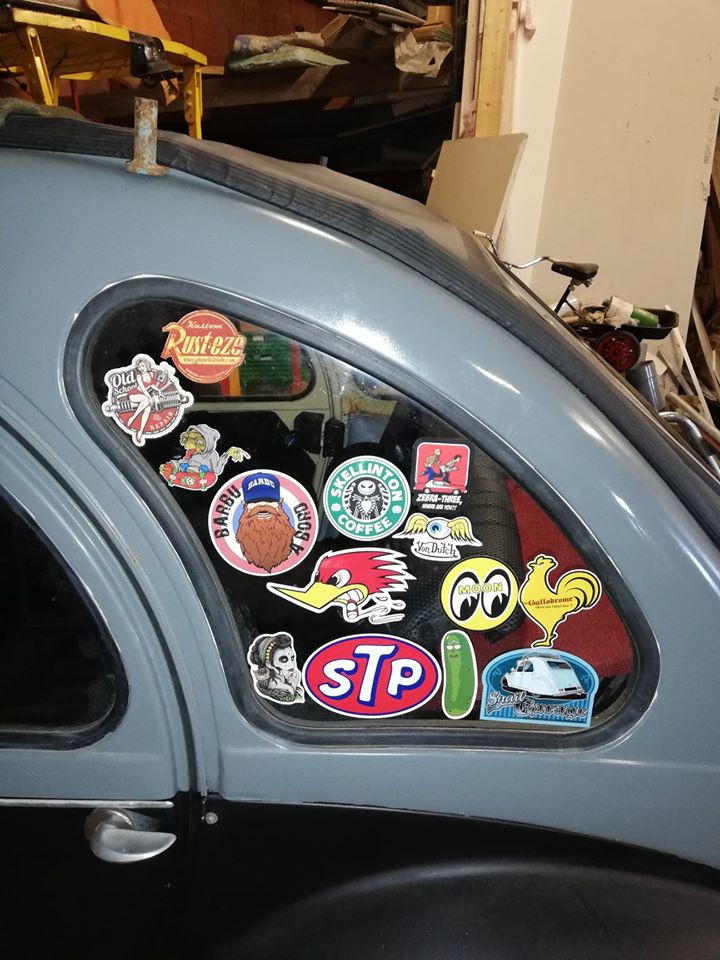
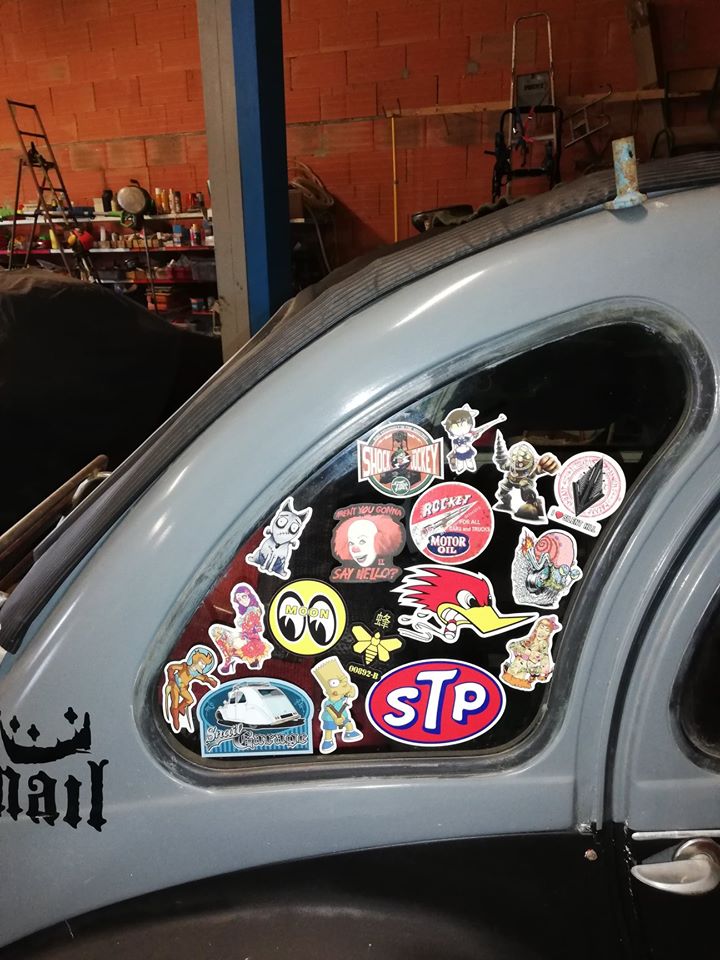
The original grey eventually bored him. He painted a two-tone finish himself, highlighted with a red pinstripe. A red roof canvas, tracked down thanks to a mutual-help group of enthusiasts, completes the look, with personalised stickers.
The story doesn't end there. The mix of wide wheels at the rear and original wheels at the front didn't please him, and he put everything back to original. But he missed the squat stance. After six months of searching, he found a craftsman near him able to widen the front wheels. The car then regained a uniform look.
Widened wheels, wide wings and lowering change a 2CV's appearance, but also its compliance. A car must stay within the specifications on its registration document to pass the roadworthiness test and remain insured. Before widening wheels or changing tyres, check with a test centre and your insurer. Our guide How to choose the right wheels explains the dimensions to respect. Julien's story is a testimonial, not a recipe to reproduce without checking.
No question of turning the Deuche into a bomb. Julien has other cars for thrills, and he kept the standard 602 cm³ flat-twin. He made only two tweaks: a complete air filter housing for the 602-engined 2CV6 and a more direct exhaust outlet, which gives it a voice without changing the character of the car.
This engine is the one that defines the 2CV6. Launched in 1970 alongside the 2CV4 and its 435 cm³, the 2CV6 received the 602 cm³, which produces 29 hp DIN (33 hp SAE). It is the most powerful version of the saloon. The 1975 2CV4 of his early days therefore belonged to the small-engined end of the range, which probably explains why it struggled against his mates' GTIs.
Inside, Julien redid everything: new door panels, carpet and seats. On top come a host of small details that amuse him and make the people he meets smile. The Deuche lends itself well to this game: people look at it kindly, and come over to talk to its driver.
All the bodywork, engine and trim parts are gathered on the Citroën 2CV page, and the references specific to each engine can be found by engine.
Julien's journey sums up the spirit of the 2CV well. A simple car that an enthusiast can get going again himself with patience and a few tools. A car that lends itself to personalisation, as long as you stay within the rules. And a car that creates bonds: a friend who finds wheels, a father who helps with transport, a craftsman who widens wheels, strangers who smile as you pass.
To place this 2CV6 in the wider history of the model, from the pre-war TPV to the last cars built in 1990, read The Citroën 2 CV: a timeless icon of French motoring. Fans of rare versions will find plenty to enjoy in The limited editions of the 2CV.
Have you too brought a classic out of a barn or a garage? Tell us its story: we will publish the best ones with your agreement.
Harald
Le partage de la Passion, simplement.
Subscribe to our MECATECHNIC newsletter