Your vehicle
No vehicle selected
Identify yours to refine your search results
No vehicle selected
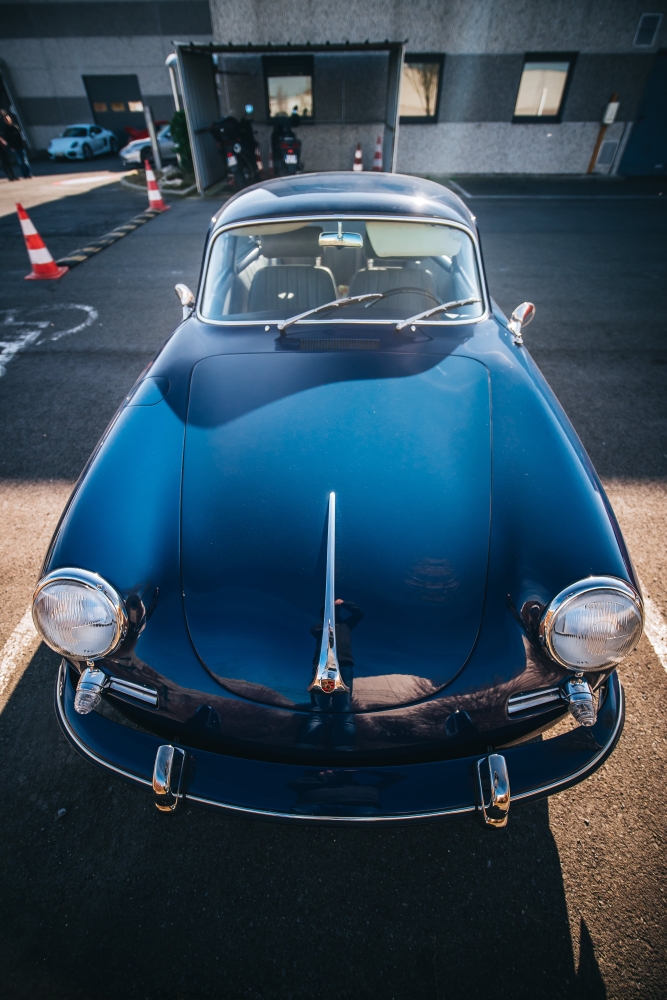
Before the 911, there was the 356: born in 1948 in an Austrian workshop, it turned Porsche into a car maker. Here is its story, from the Gmünd roadster to the 356 C, with the clues to recognise each generation.
22/10/2026
Harald
7 minutes read
Every Porsche descends from it. Before the 911, before the victories at Le Mans and the models of more than 500 hp, there was a small air-cooled, rear-engined sports car, designed in a hurry in the post-war years with Beetle parts. The 356 was produced for seventeen years, in around 76,000 units, and turned a design office into a full-fledged car maker. Here is its story, from the Austrian workshop at Gmünd to the last 356 C.
At the end of the war, the Porsche design office had withdrawn to Gmünd, in Carinthia, in southern Austria. It was there that Ferry Porsche, Ferdinand's son, had the first car bearing the family name built. The 356 "No. 1" Roadster was granted road approval on 8 June 1948, a date Porsche regards as the birth of the marque.
This prototype does not look quite like the production 356s. Its chassis is a lattice of steel tubes clothed in an aluminium body designed by Erwin Komenda, and its engine sits ahead of the rear axle. The mechanics come from Volkswagen: a flat-four of 1,131 cm³, air-cooled, pushed to 35 hp. For a roadster of about 600 kg, that is enough to reach 135 km/h. A one-off, No. 1 is now preserved by the Porsche museum.
For series production, Porsche installed the engine behind the rear axle, as on the Beetle: this freed up room for two small rear seats and simplified manufacture. The first cars, around fifty or so, were built by hand at Gmünd, with aluminium bodies. In 1950, Porsche returned to Stuttgart-Zuffenhausen and entrusted the manufacture of steel bodies to the coachbuilder Reutter.
The first 356s still borrowed a great deal from the Volkswagen: gearbox, brakes, suspension and steering. Porsche gradually freed itself from this. From 1951, 1.3 and then 1.5 litre engines appeared, markedly more powerful than the 1.1 litre of the early days. The same year, a lightened 356 with an aluminium body raced at the 24 Hours of Le Mans in the 1,100 cm³ class.
The 356s produced up to 1955 had no letter. Today they are called "pre-A" to distinguish them from the later generations. Their surest identifying feature is the windscreen:
The pre-As were offered as coupé and cabriolet, with 1.1, 1.3 and 1.5 litre engines, in normal and S versions. The 1500 S develops 70 hp.
Very early on, the United States became an essential market for Porsche, thanks to its New York importer Max Hoffman. In 1952, at the request of the American market, Porsche had a very small series of aluminium-bodied roadsters built by the coachbuilder Gläser: this was the America Roadster, fitted with the 70 hp 1500 S. Sources do not agree on the exact number built, somewhere between fifteen and twenty, which makes it one of the rarest 356s.
At the end of 1954, Hoffman obtained a stripped-down and cheaper open version, designed for customers who drive at the weekend and race on Sunday: the Speedster. Low, raked windscreen, minimalist hood, removable side windows: it became one of the most emblematic 356s, and one of the most copied.
At the end of 1955 the 356 A appeared, with its one-piece curved windscreen and a padded dashboard. The range had five engines: 1300, 1300 S, 60 hp 1600, 75 hp 1600 S, and a model in its own right, the Carrera.
The 1500 GS Carrera, named after the Carrera Panamericana race, received the engine designed by Ernst Fuhrmann: a four-cylinder with four overhead camshafts, derived from competition, developing 100 hp in its first version. A useful clarification, because the mistake is common: the first production Carrera is a 356 A, not a pre-A. Carreras would accompany the 356 to the very end, with the 2-litre Carrera 2 offered on the 356 B and C.
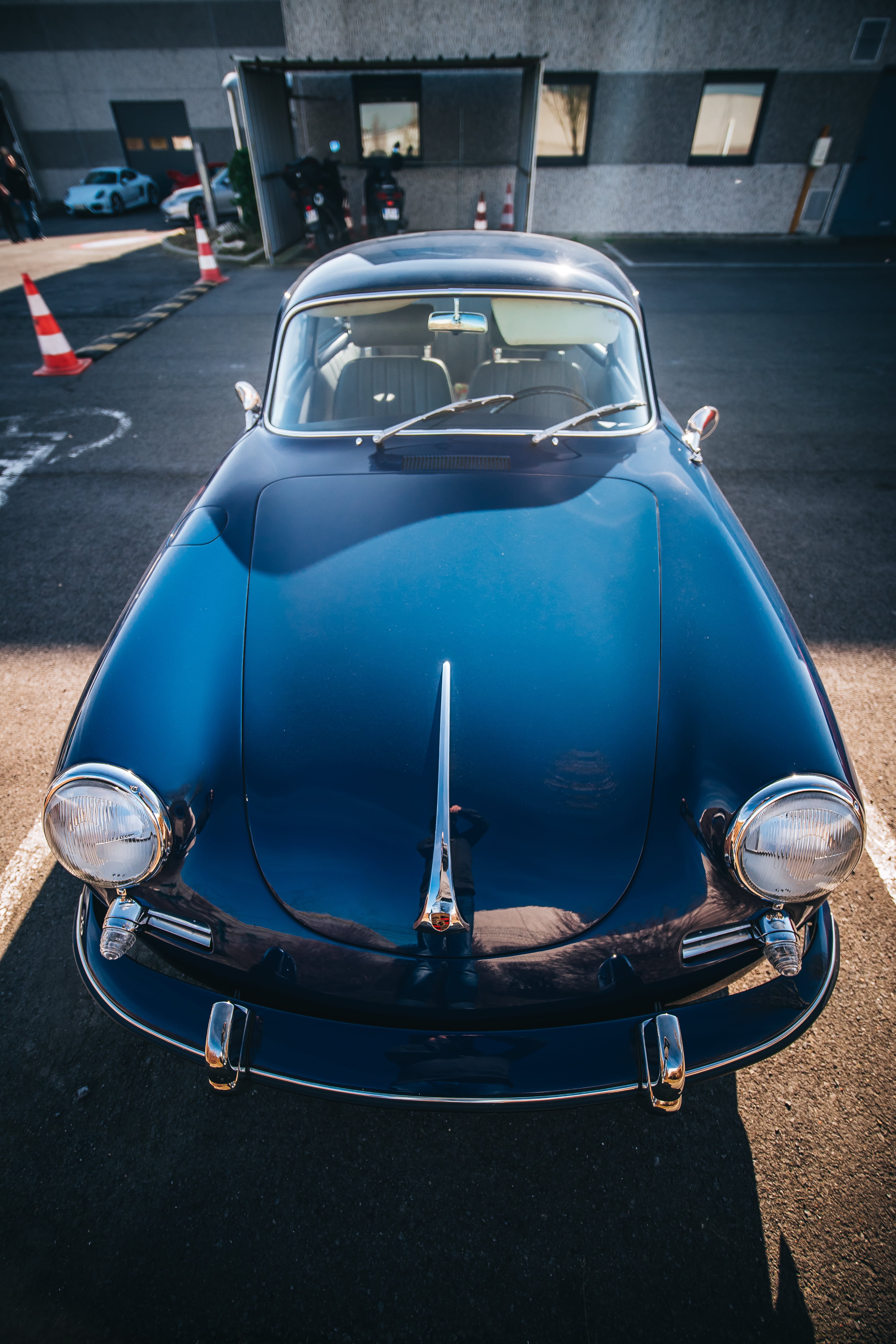
The 356 B modernised the line: the front bumper was raised by about ten centimetres and the headlights were placed higher, which changes the car's expression. In 1962, the body evolved again (we speak of T5 for the first B, T6 for the second): the T6 can be recognised by its two ventilation grilles on the engine lid and its external fuel filler flap on the right front wing. Karmann also produced a rare coupé with a welded roof, known as the "hardtop" or "notchback".
Launched for the 1964 model year, the 356 C looks very much like the last B, but it received disc brakes on all four wheels, which required new wheels and new hubcaps. The SC version and its 95 hp 1.6 litre are the most powerful pushrod engine ever fitted to a 356. Production stopped in 1965: the 911 had taken over, supported by the four-cylinder 912.
These clues give a first indication, but a 356 has often been through several restorations. The chassis number and the engine type remain the only reliable references when ordering parts.
Being a monocoque, the 356 is prone to corrosion, and a bodyshell restoration can quickly become a heavy job: floors, sills and chassis legs should be examined before any purchase. On the mechanical side, the pushrod four-cylinder is simple and endearing, but it needs careful carburation and ignition settings.
Rear engine, air cooling, flowing bodywork and lightness: everything that would make the 911 is already in the 356. For the rest of the story, read our article on the Porsche 911, the benchmark sports car, and for its mechanical roots, the one devoted to the Volkswagen Beetle. All the parts are gathered on the Porsche 356 page.
Harald
Le partage de la Passion, simplement.
Subscribe to our MECATECHNIC newsletter