










Your vehicle
No vehicle selected
Identify yours to refine your search results
No vehicle selected
Read more
3 Results
sort by
Only 2 left in stock
On order, from 19 days
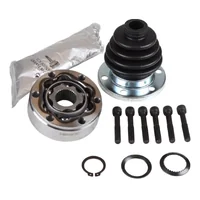
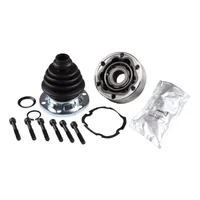
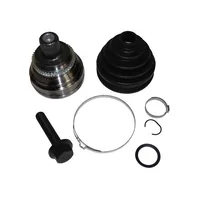
A driveshaft must rotate at a constant speed even though its two ends are never aligned: the wheel turns and the suspension moves. This is the role of the constant-velocity joint, which transmits torque smoothly regardless of the angle, unlike a simple cross-type universal joint.
In everyday usage, the three terms are often used interchangeably. Technically, the tripod housing slides and the ball joint steers.
A drive shaft carries a joint at each end, and they do not operate in the same way.
They are never interchangeable, and their dimensions differ even on the same vehicle. You should therefore always check the side before ordering, and note it down from the part you have removed rather than guessing.
A universal joint almost never wears out on its own. It fails because its boot has split. As soon as the tear appears, the grease escapes due to centrifugal force, and water, dust and salt get in. Within a few hundred kilometres, the raceways are pitted and the part is ruined.
Checking the boots every time you work under the car, with the wheels turned fully to one side to inspect the folds, is therefore the most cost-effective way to check the front suspension. A boot replaced in good time costs a fraction of the price of a complete ball joint. If replaced too late, it won’t save anything: fresh grease cannot repair balls that are already worn.
Order the complete kit where available, including the boot, clamp, suitable grease and retaining rings. Fitting a new steering knuckle with a worn original boot means you’ll have to do the job all over again the following year.
Consult the details of the engine variants, chassis and versions offered for this model