Your vehicle
No vehicle selected
Identify yours to refine your search results
No vehicle selected
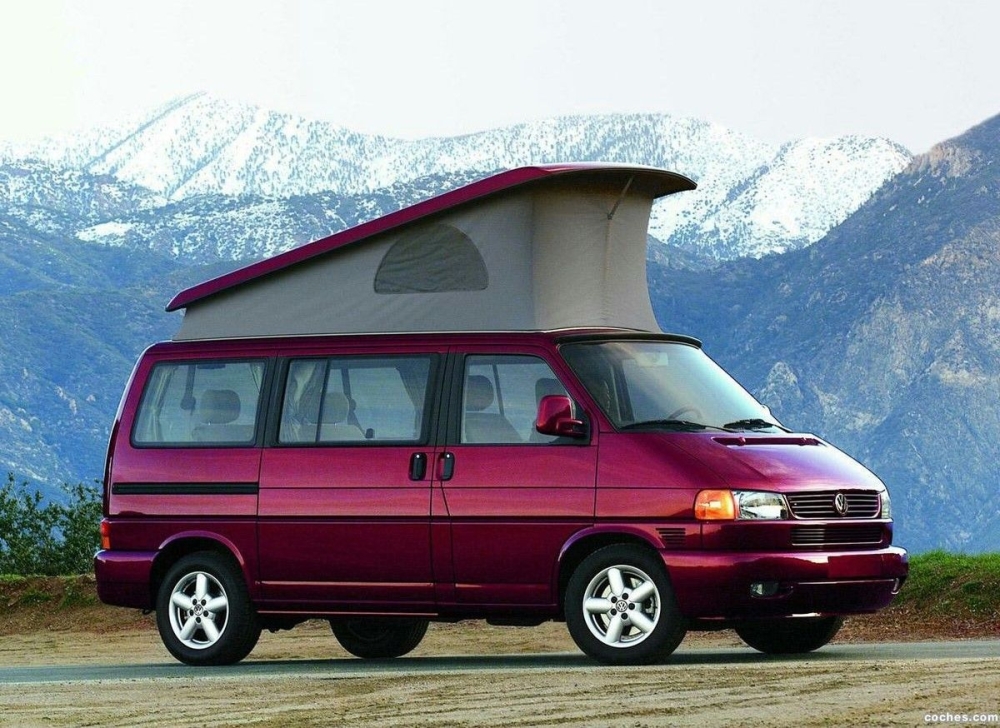
With the Transporter T4, Volkswagen enters the modern era of the camper van. TDI engines, modularity, Westfalia California and Multivan versions: a versatile van that became a benchmark of the 90s.
10/03/2026
Harald
10 minutes read
Volkswagen
Full steam ahead! That could have been VW's slogan for the launch of the fourth generation of its legendary Transporter.
The public met the fourth Transporter in 1990. The Split-Screen Camper or T1, the Bay Window Camper or T2 and the third, the T3 or Transporter 25, had all been smash hits in their day and VW could not afford to miss when radically modernising its flagship van.
The T4 was quickly crowned with success in all its markets: the Kombi van and its many special bodies delighted tradesmen and shopkeepers; the Multivan , which carries 7 people, is as modular as you could wish; and the camper version developed by Westfalia delighted families in search of freedom.
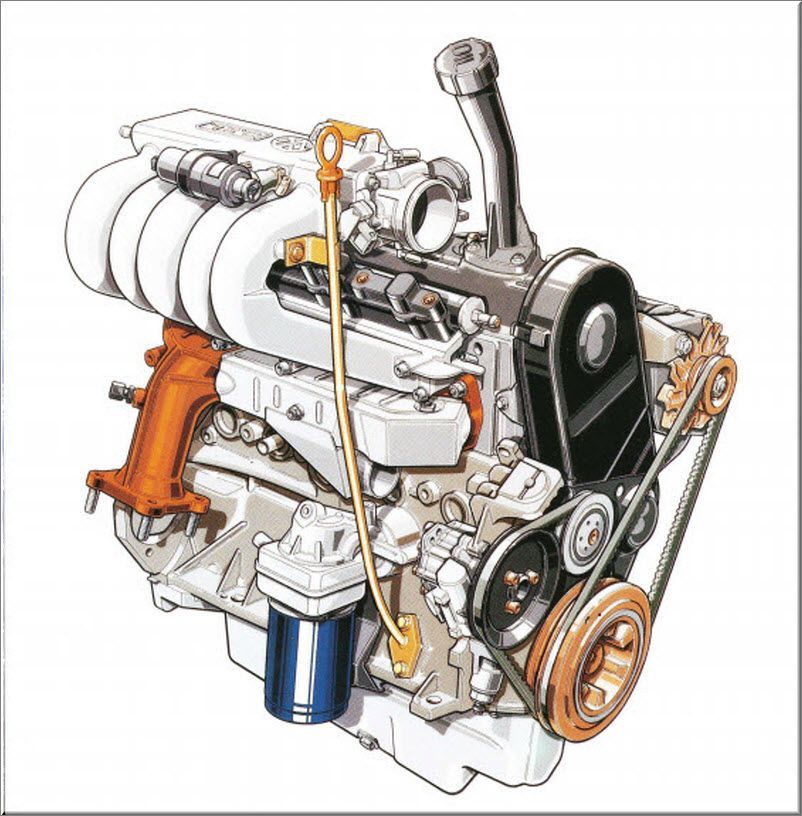
The success of the T4 in "van life" mode is partly due to its reliability, its toughness and the comfort it brings, both on the road and when "camping". It is an easy vehicle to find, often more affordable than a T3. You can fit it out as you please; its many engines, including the famous TDIs, make it a torquey, powerful and frugal vehicle; gone are the holidays at 70 km/h with an average of 12 litres to the hundred. Another advantage, and not the least, is that spare parts and accessories are available at very reasonable prices thanks to its wide distribution.
I almost forgot… standard or with a pop-top (closed!), it just fits under the 2 metre mark: it goes into every car park, gets into town where it stays discreet, and it remains in the small class (car) at motorway tolls. Isn't that beautiful?!
The basis of leisure T4s is almost always the same: a van fitted out for 4 people.
The space offered by a T4 equipped for living in is ideal for a couple and two children. A living area with a bench seat, a removable table, a mini sink, a hob, a small refrigerated space, another for the small gas bottle, storage… swivelling front seats, a pop-top roof to be comfortable inside, fitted with a mattress bed for 2 (small) people. The bench seat and its cushions turn into a comfortable bed for 2 adults (who love each other, ideally, as it is only a slim 120 wide).
Add specific ventilation, curtains, a battery and a parking heater, a 27L container for waste water and you are in a rolling holiday home, with no planning permission and none of the taxes that go with it. Isn't life great?
Westfalia, VW's inseparable partner since 1951, remains the emblematic name that camper history will retain when it comes to "VolksVans". A VW camper conversion? A Westfalia, of course.
Right up to the Transporter 5, it was Westy (Westfalia's nickname) that assembled Volkswagen's leisure vans. They are generally very well finished, with quality materials, which lets them cross the decades without ageing too much. Good news for those of us who are now taking an interest in them!
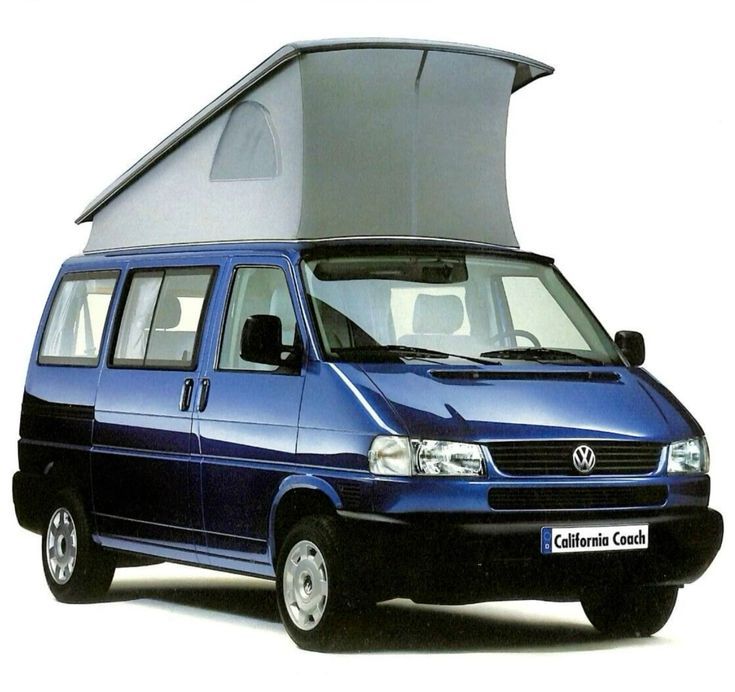
The name Westfalia California, which appeared in 1988, evokes wide open spaces, the ocean and beaches; it is perfect for naming the "camper van" formula offered by VW for adventure on wheels with the T4.
The VW brochure of the time was headlined: "California, the new benchmark for leisure".
The California became the California Camper and then the California Coach as the model evolved; it served as the base for quite a few special editions, created for VW's marketing needs, while delighting customers who liked an upgrade in equipment.
Among the best known are:
One of the first, in 1994, based on the long chassis and with a raised (fixed) roof; tall people will be comfortable in it with an interior height of 2.05 m! It is the most spacious of all. Ideal for touring California, or the world, as a couple.
1995, well equipped with a rack for 4 bikes as standard. It was offered in off-white… or metallic grey-blue (bluey-grey?); a particular feature: its very slightly raised fixed roof, known as "compact", does not allow you to sleep in it but makes storage easier.
It came out in 1994 and was improved in 1996 with phase 2. It was powered by 5-cylinder Diesels (TD / TDi) and by the powerful VR6 from 1996. Its particular feature: a large raised hard roof, equipped with a cab-over bulge (a Smurf-hat-shaped extension) above the cab.
A limited Highway series of 500 units was produced in 1995 to celebrate 150 years of Westfalia.
In 1996, with 500 units, it evokes the beach through its finishes and its sandy beige interior colours, as well as its pop-top canvas. A small peculiarity: it skips the kitchen area and gains extra storage in its place. It could be ordered in 4, 5 and even 7 seats: a sort of multi-camper van!
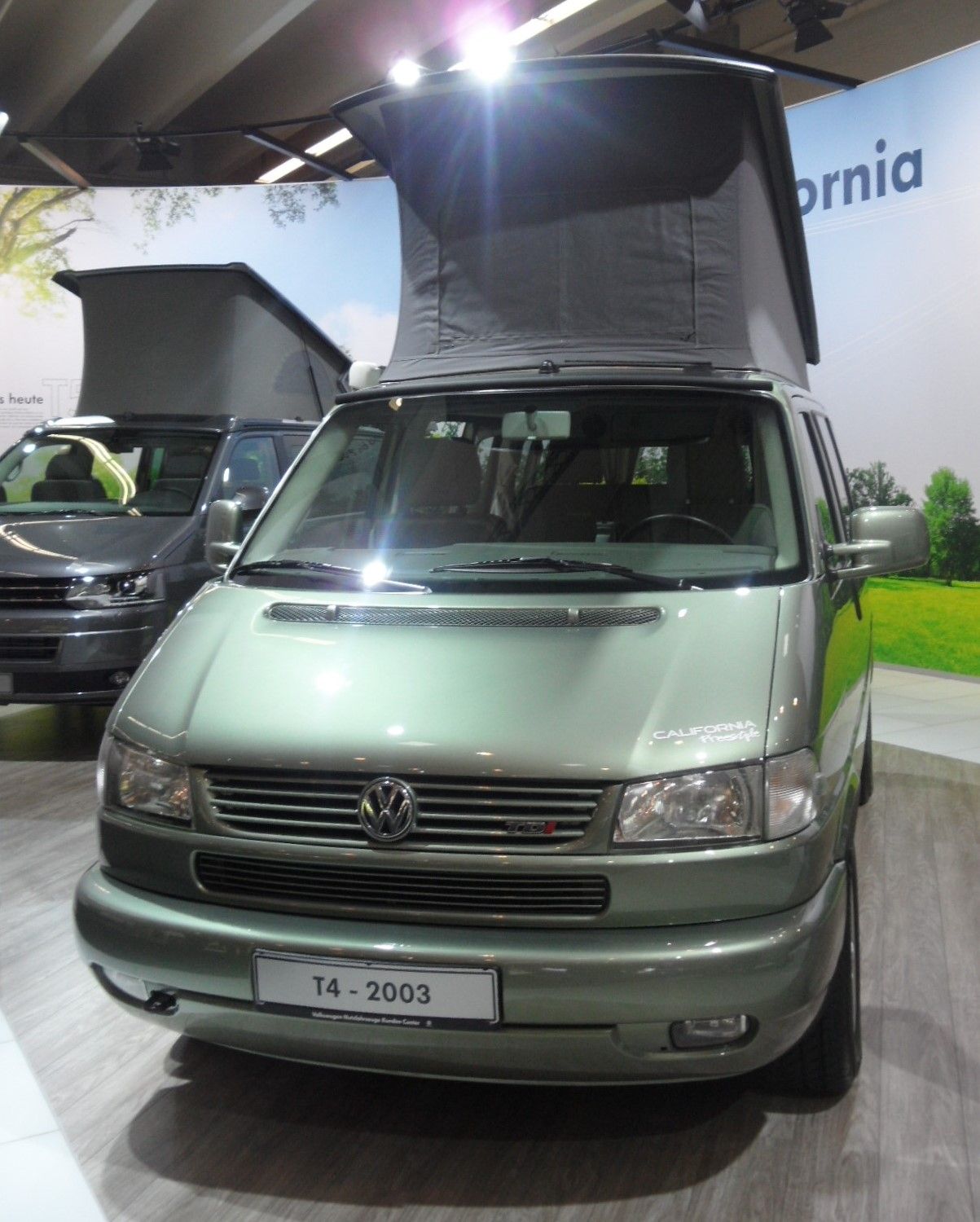
In 1999 came the California Blue, with air conditioning and a parking heater; bumpers painted in body colour (Techno blue metallic).
It arrived in 2000, available in 5 colours including the eye-catching Tornado red; alloy wheels were optional, while the 3-bike rack was standard.
Westfalia, about to end its 50-year partnership with VW in 2002, released a special California Event series, commemorative and very well equipped.
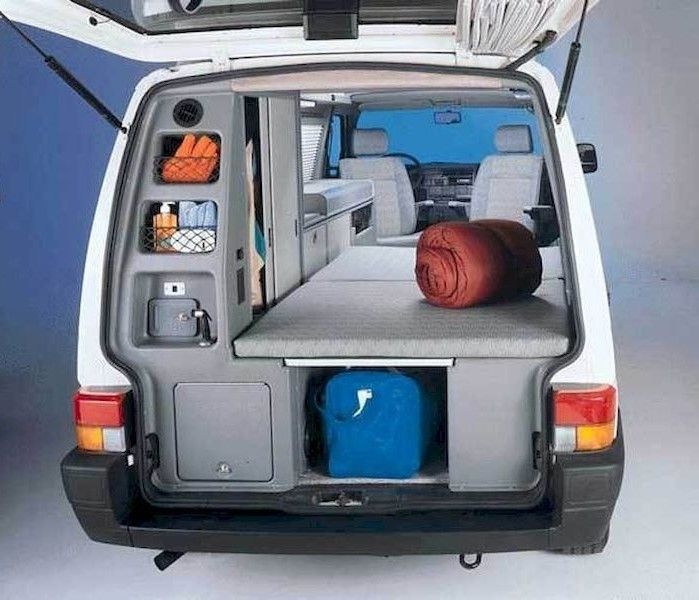
The Joker name returned to service in 1997, again for 500 units, in Arctic blue or pistachio green; with a tailgate bike rack.
The following year, the Westfalia T4 Freestyle would be one of their last joint series, before making way for the T5 "made in Volkswagen".
Westfalia was not the only one to offer a camper van solution based on the T4. Karmann, VW's other coachbuilder, got to work on it and even released a luxurious T4 on a long chassis, with a raised roof and a cab-over extension (a bulge), the Colorado. Let's not forget the conversion specialists either, such as Germany's Reimo or the British Autohomes,
Explorer and Auto Sleepers, who took advantage of the long chassis to give the camper T4 a new dimension.
Alongside the official ones, resourcefulness and "Do It Yourself" (DIY) are in full swing among private owners who set about fitting out their standard T4 to turn it into a camper van.
It is not new, but internet tutorials, blogs, YouTube, new materials, new portable tools and so on allow handywomen and handymen to get closer to the joy of driving a motorhome at lower cost.
One caveat to remind you of: the registration document (carte grise) of a van fitted out from the factory or converted by a manufacturer carries the mention "VASP " in J1. What on earth is that? This annotation, for Véhicule Automoteur Spécialisé (specialised motor vehicle), certifies that it complies with the EEC type-approval standards for its conversion (motorhome, ambulance, van for working the markets …). The materials used, the electrical modifications, the ventilation, the reinforcement and fixing points, the passive safety, the weight distribution and so on and so forth meet standards that nobody explains to you in DIY stores.
If you divert the main use of a vehicle such as a van (CTTE) or an 8-seater van to turn it permanently into a motorhome, you are required to take it to the DREAL (in the Nord region, we used to call it the Mines). After inspections, you may obtain the key that will let you have your registration document modified. Needless to say, it is not a given and the ground is a minefield. And if you don't do it? At the contrôle technique (the French roadworthiness test), non-compliance with the registration document is a major defect: you will have to take a retest within two months, and it will only be favourable once the situation has been regularised. With all the problems that this entails for driving.
The solution? Modules to make it modular… We come back to one of the main qualities of a Transporter: its mo-du-lar-i-ty! Use it to stay on the right side of the rules.
More and more specialists and joiner-fitters offer turnkey kits, very well thought out, that let you use your Transporter as a Van or Multivan during the week and, by emptying it on Friday evening, turn it into a camper van for the weekend.
These modules that you slide and fix into the van, you can also build yourself; all is not lost when it comes to the pleasure of fitting out your own way and saving money. As long as you present your vehicle "unfurnished" and "re-seated" at the CT, you will be in order. Your modules, mattress and so on become transported objects. At the very least, take care to respect the safety prerequisites (ventilation, electrical installations and so on).
And the pop-top? For the children, or for a couple of friends, you can opt for a 2-second tent, or, for fun and comfort, a roof tent on a roof rack with a retractable ladder; they are more and more affordable.
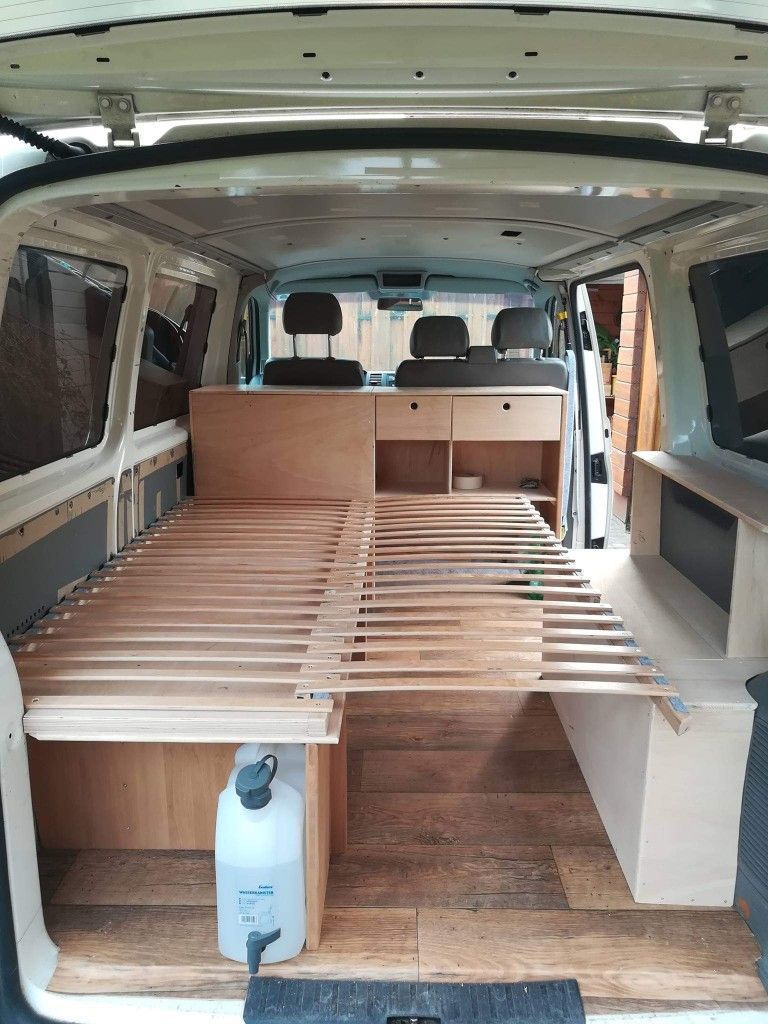
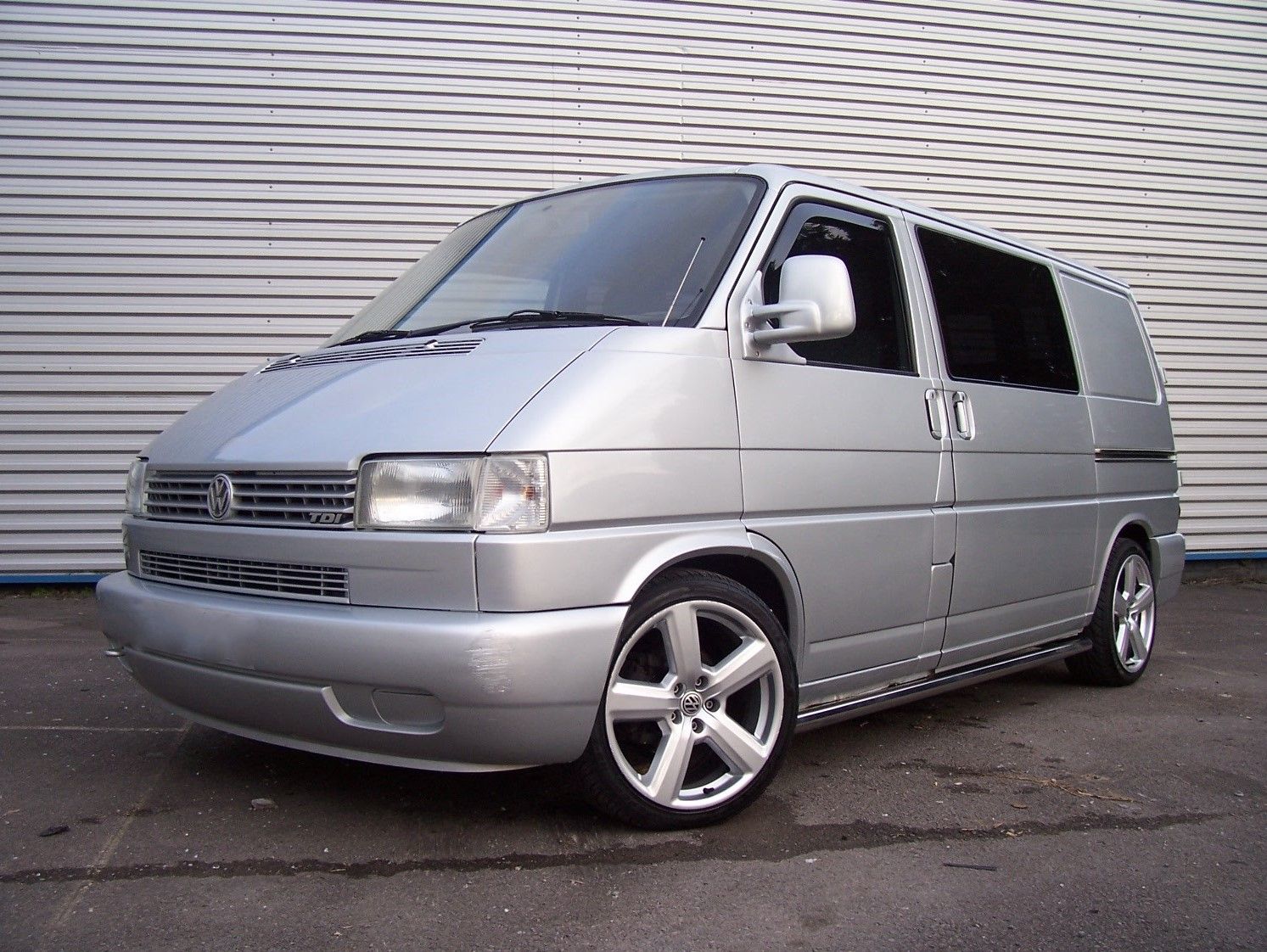
Will and Gina dreamed of a T2 or a T3. The budget and the adverts led them to a 2.5 TDI T4 from 2000, in panel van form, in very good condition. Novices in mechanics as well as in conversion, they began by reading a lot: specialist sites, feedback from friends, advice from mechanics. Then came the sketches, the plans and the choices: insulation, wood, equipment, electrics, gas, and above all the position of each item.
The first job, the most intimidating: cutting into the bodywork to fit a roof vent. The rest followed step by step, up to the day of the paint job that turned their commercial vehicle into a real van.
A van converted this way remains a van on its registration document: reread the paragraph above on the VASP mention and the trip to the DREAL before you hit the road.
While it may lack the Vintage side that charms young and old alike like the first 3 can, the Transporter 4 is now part of the vans of the Youngtimer generation and its value remains strong on the used market. Its many qualities, and its efficient, economical Diesel engines, have allowed it once again to climb to the top of the hit parade of leisure vans.
By going from everything at the rear to everything at the front, Volkswagen's van managed to catch up with the spirit of its time. Will the next generation, the Transporter 5, do as well for camping and leisure in its 100% VW version?

Harald
Le partage de la Passion, simplement.
Subscribe to our MECATECHNIC newsletter