















Your vehicle
No vehicle selected
Identify yours to refine your search results
No vehicle selected
Read more
6 Results
sort by
Only 2 left in stock
On order, from 23 days
On order, from 13 days
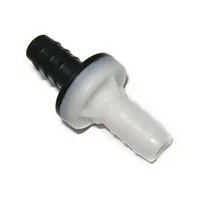
Only 3 left in stock
Only 5 left in stock
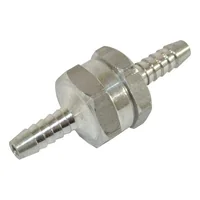
Only 1 left in stock

The brake booster operates using the vacuum created by the engine. However, this vacuum is not constant: it disappears when the throttle is fully open and, of course, when the engine is switched off.
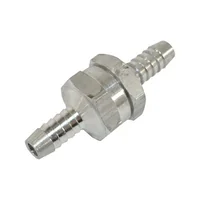
The non-return valve solves this problem. Positioned between the manifold and the brake booster, it allows air to flow out of the brake booster towards the engine, whilst preventing flow in the opposite direction. The brake booster therefore stores the best vacuum it has achieved, and the assist remains available at times when the engine is no longer producing any. This is what allows you, with the engine off, to make two or three more assisted braking manoeuvres before the pedal becomes hard to press.
Run the engine for a few minutes, then switch it off. Next, press the brake pedal several times in quick succession. The first two or three presses should remain assisted, after which the pedal gradually becomes stiffer.
If the very first press is already stiff, the vacuum reserve is not being maintained: the problem lies with the valve or the hose connecting it. If, on the other hand, the vacuum reserve holds but the power assistance is lacking whilst the engine is running, the valve is working correctly and the fault lies elsewhere. Second test, just as simple: remove the valve and blow into it in one direction, then the other. It must allow air to pass freely in only one direction and be completely airtight in the other.
A non-return valve has a specific direction of fit, and this isn’t always obvious to the naked eye. An arrow, a moulded mark or a difference in diameter between the two ends will indicate this. If fitted the wrong way round, it will cut off the power assistance from the very first attempt, and the symptom will look exactly like a faulty brake booster.
If in doubt, blow through it: air should pass through when blown from the brake booster side and be blocked when blown from the manifold side. Also check the base seal when the valve fits directly into the brake booster: this rubber seal hardens and can cause a leak on its own, even if the valve is in good condition. It should be replaced at the same time.
In some set-ups, the valve is a separate part that fits into the hose; in others, it is integrated into the vacuum tube, moulded as one with it, and the whole unit is replaced as a single assembly.
Check your set-up before ordering: if the valve is integral with the tube, a valve on its own will be of no use to you. And if your hose is softened or split at the ends, buy the whole assembly: a new valve fitted to a hose that collapses will not restore the power assistance, and you’ll have to take it apart again. Both parts are the same age and operate under the same conditions.
Consult the details of the engine variants, chassis and versions offered for this model