Your vehicle
No vehicle selected
Identify yours to refine your search results
No vehicle selected
Read more
20 Results
sort by
Only 4 left in stock
Only 2 left in stock
Only 2 left in stock
Only 2 left in stock
Only 2 left in stock
Only 2 left in stock
Only 2 left in stock
Only 1 left in stock
On order, from 16 days
On order, from 16 days
Out of stock
On order, from 16 days
On order, from 16 days
On order, from 16 days
On order, from 16 days
On order, from 16 days
On order, from 16 days
On order, from 16 days
On order, from 16 days
On order, from 16 days
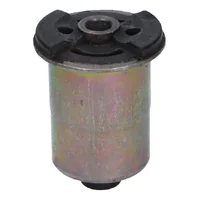
A silent block is a flexible joint: a rubber sleeve clamped between two metal rings. It fulfils two functions at once, and people always forget the second one.
When the rubber is split or has come away from its sleeve, the component no longer guides anything: the control arm develops play, the suspension angles vary under load, and the car becomes imprecise before becoming noisy. This is why a wheel alignment check on worn rubber bushings is pointless.
A useful test: jack up the vehicle and gently pry the arm with a bar. Any noticeable play at the pivot point is abnormal, even if there is no noise.
Rubber is the original material. It absorbs vibrations well, deforms significantly and remains quiet. On the downside, it ages: it hardens, cracks and fails after one to two decades.
Polyurethane is harder and much more durable over time. It eliminates almost all play, improves road holding and lasts significantly longer. There is a real trade-off: more vibrations and road noise are transmitted into the bodywork, and on some fittings it needs to be lubricated during fitting with a suitable grease, otherwise it will squeak. It is the right choice for a sports car or a vehicle whose suspension has already clocked up a fair bit of mileage; for a period-correct restoration and leisure driving, rubber remains the better option.
The suspension travel stops, which limit the suspension’s travel at the end of compression, should be replaced at the same time: they are often crumbled and nobody pays them any attention.
A silent block is press-fitted into its housing. Hammering it out or using a jet of water deforms the housing, which will then no longer hold anything in place: a press or a screw-type extractor is required, which pushes along the axis and provides proper support. A silent block fitting tool avoids the need to remove the control arm, which makes all the difference on a front suspension.
The second rule is less well known but just as important: on a sleeve-type joint, final tightening must be carried out with the vehicle on the ground and the suspension loaded to its normal position. If tightened whilst the vehicle is off the ground, with the wheels hanging free, the rubber becomes pre-stressed in torsion as soon as it returns to the ground. It then operates constantly outside its operating range and will tear within a few thousand kilometres. This is the most common reason why a new silent block fails.

Consult the details of the engine variants, chassis and versions offered for this model