























Your vehicle
No vehicle selected
Identify yours to refine your search results
No vehicle selected
Read more
1 Results
sort by
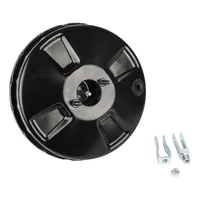
Three words for a single component. Mastervac was originally a trade name, but has become so widely used that it has replaced the technical term. Brake booster and brake force amplifier refer to exactly the same component: the large cylinder situated between the pedal and the master cylinder.
The principle is simple. A diaphragm separates two chambers; on one side, the vacuum drawn from the engine; on the other, ambient air when you press the pedal. The difference in pressure pushes the diaphragm, which adds its force to yours. This is why braking is still possible, albeit with great effort, when the brake booster fails.
The test takes two minutes and is carried out whilst the car is stationary. With the engine off, press the pedal five or six times to use up the vacuum reserve: the pedal should become hard to press. Keep your foot on the pedal and start the engine. If the brake booster is working, the pedal will sink noticeably under your foot as soon as the engine starts. If nothing happens, the booster is not providing assistance.
Before ruling out the brake booster itself, check what supplies it: the vacuum hose may be cracked or worn, and the non-return valve may remain open. These two parts cost a fraction of the price of the brake booster and cause exactly the same symptom. A whistling noise when braking and erratic idling when the pedal is pressed suggest a leak, not a problem with the diaphragm.
On older set-ups, the part that fails is almost always the diaphragm – which has hardened and cracked – or the seal between the brake booster and the master cylinder. The housing itself is generally in good condition. A repair kit therefore serves the same purpose as a standard replacement, at a fraction of the price, and keeps the original part on the car, which is important when the part is no longer available new.
Complete replacement is justified when the body is corroded, when the push rod is bent, or when the unit is still available as a new part at a reasonable price. In any case, check the condition of the master cylinder at the same time: the two parts are coupled together, and there is no point in removing them twice.
On modern vehicles, the parking brake is no longer operated by a cable but by an electric servomotor integrated into the rear brake caliper. This motor has a similar name but is entirely unrelated to the brake booster: it does not operate using vacuum, it does not contribute to service braking, and it can be diagnosed using a diagnostic scanner.
If your brake pedal feels stiff, it’s the brake booster. If it’s your electric parking brake that won’t release, it’s the caliper actuator.
Consult the details of the engine variants, chassis and versions offered for this model