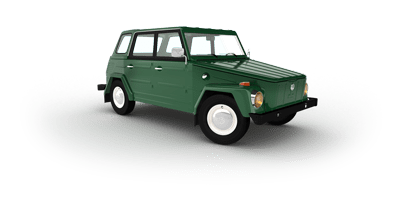









Originally designed for the military before appealing to civilians, the 181 was based on the Beetle platform with its air-cooled flat-four engine and mechanical simplicity. Rustic, convertible, almost utilitarian, it didn't try to be modern. It focused on robustness and ease of maintenance. A functional Volkswagen, without frills.
In 1969, VW presented an all-road vehicle: the 181, a two-wheel drive vehicle, in the spirit of the Kübelwagen produced during the Second World War. This sheet metal Méhari: as many have nicknamed it, took the name of its production type: 181 or Thing (the thing as it is called in the USA). Designed at the request of the German army in the face of the delay of the Jeep project, the concept 181 is a light, robust and reliable vehicle. Coming from the association of Beetle, Karman-Ghia and Combi parts, the production of this military vehicle started in 1970; a civilian version is quickly marketed. The first version of the 181 used the rear axle of the Combi Split, with a gearbox equipped with reduction gears ideal for crossing but painful on the main road. From 1973, it was equipped with the more modern gearbox with gimbals of the Cox of the time; driving comfort is thus significantly improved. The success will not have been as expected but the 181 will have seduced all the same by its simplicity and its reliability. Exported across the Atlantic from 1973, the VW 181 met with great success there but, not meeting the draconian safety and pollution standards that prevail in the USA, it was withdrawn from the market after only 2 years. The production of the VW type 181 will stop in 1980.